
Floor Screeding Contractors Essex
Why Liquid Screed Delivers Peak UFH Performance in Essex Builds
Every screed pour has two priorities – structural stability and heat transfer. Liquid (anhydrite) screed is now the standard for heating installations for a simple reason – complete pipe encapsulation with no air voids.
When paired with low-temperature heat pumps or modern condensing boilers, liquid screed encases your underfloor heating (UFH) in a dense, thermally responsive mass that cuts running costs and speeds up heat delivery.
Buxton Flow Screeds are floor screeding contractors in Essex with over 20 years of site screeding. We don’t just pump screed – we manage the substrate, verify flow rates, and guarantee levels that guarantee a flat, stable base for following trades.
Why Liquid Screed Outperforms Semi-Dry Mixes
Underfloor heating relies completely on surface contact. Traditional semi-dry sand and cement screed provides around 1.1 to 1.3 W/mK thermal conductivity and requires manual mixing and tamping. The manual installation inevitably leaves air pockets around heating pipes. And because trapped air is a thermal insulator, those pockets limit heat transfer and force heat sources to run hotter and burn more energy.
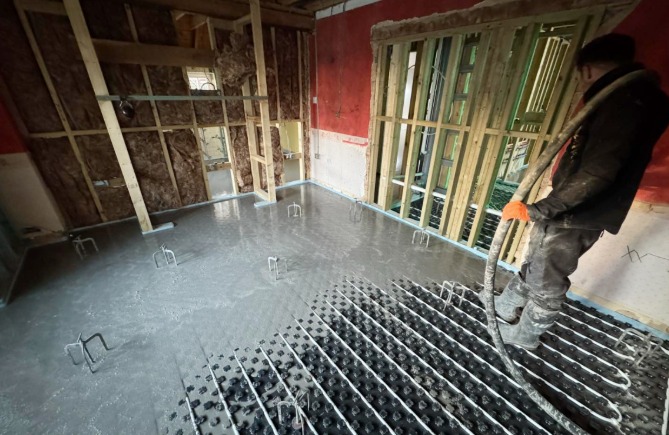
Liquid anhydrite screed delivers a thermal conductivity up to 2.2 W/mK. The fluid mix wraps 360 degrees around every pipe loop, eliminating thermal barriers completely.
- Thinner Thermal Bed – Liquid screed covers pipes at just 30mm depth (compared to 65mm–75mm for sand and cement).
- Faster Response Times – Rooms heat up in 30 to 45 minutes instead of taking hours to fight through thick, dense concrete.
- Lower Flow Temperatures – Direct pipe contact allows heat pumps to run at optimal 35°C–45°C design temperatures, maintaining seasonal efficiency.
Correcting Subfloor Tolerances Before the Pour
A liquid screed pour cannot fix a structurally defective or deeply uneven subfloor on its own. For an underfloor heating system to perform correctly, the structural base must sit within BS 8204 Surface Regularity tolerances. If a base slab dips or rises wildly out of level, screed depth varies across the room. That variation causes uneven heat output, screed cracking over high spots, and potential pipe flotation.
When structural slabs sit outside acceptable tolerances, we level the substrate before installing insulation and UFH pipework.
On-Site Solution – Levelling a 35mm Base Deviation in Dovercourt
On a 28m² domestic subfloor preparation in Dovercourt, previous builders left an uneven slab running up to 35mm out of true. Pouring standard screeds would have halted the project for weeks waiting on drying times, while laying floor coverings directly over the uneven base would have triggered subfloor failure.
The Spec – We specified 60 bags (1.5 tonnes) of high-build, fibre-reinforced renovation screed.
The Prep – Our screeders removed surface laitance, vacuumed all dust out of concrete pores, sealed the base with an acrylic primer to stop moisture draw, and set laser depth pins across the 28m² area.
The Result – Poured with a four-man crew using continuous wet edges, the 35mm build self-cured under tension. The client had foot traffic back on the floor in 4 hours, and floor layers took over a flat, stable substrate in 48 hours.
Addressing level variations at the preparation stage protects your project timeline and ensures uniform screed depth across the heating zone.
The Buxton Installation Method – Precision on Site
Pumping liquid screed requires tight site coordination. Our installation workflow controls depth, consistency, and curing from setup to handover:
- Tanking & Perimeter Isolation – We inspect tanking and fit foam expansion strips around all walls, doorways, and pipe penetrations to absorb thermal expansion without cracking.
- Flow Verification – Before pumping begins, we run flow-cone testing on site to check that the mix viscosity matches pipe spacing and flow requirements.
- Pumping & Complete Encapsulation – We pump the fluid mix systematically, working to laser tripods to maintain consistent cover over pipe crowns while forcing trapped air out from beneath pipe clips.
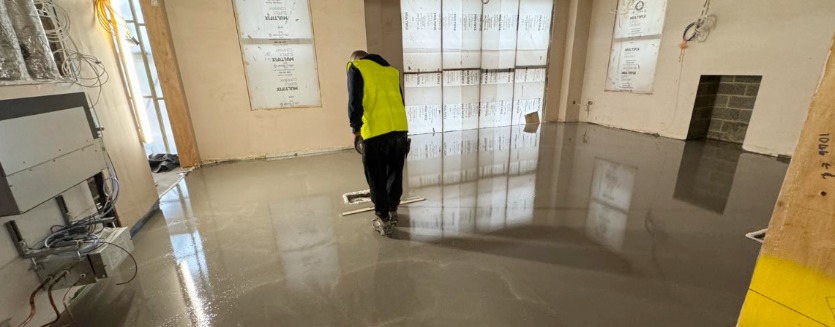
- Surface Dappling – Crews work the wet screed with dual dapple bars in cross directions to level the surface, break surface tension, and leave a clean finish.
- Curing Window – The site remains sealed for 24 to 48 hours to protect early strength development before clearing the floor for light foot traffic.
Commissioning and Moisture Verification
Liquid screed cures quickly, but you can’t rush floor finishes onto a wet substrate. If you skip the proper commissioning you’ll trap moisture, causing floor adhesives and timber finishes to fail.
- Sanding the Surface (7–14 Days) – Anhydrite screeds can form a fine surface laitance as moisture exits. We recommend sanding the surface within 5 to 14 days of pouring to remove this skin, open the aggregate pores, and accelerate moisture release.
- Controlled Thermal Ramp – After 7 days of natural curing, bring the UFH online at 25°C using manifold blending valves. Step the temperature up by 5°C every 24 hours until reaching 50°C (or maximum design temperature), hold for several days, and step back down.
- 48-Hour Rest Period – Shut off the heating system for 48 hours to allow the substrate to cool and stabilise before testing moisture levels.
- Data-Verified Sign-Off – Never lay finishes on visual estimates. Test the screed using a digital hygrometer sleeve or carbide bomb test. Moisture readings must confirm relative humidity at or below 75% RH for resilient floorings, and 65% RH for solid wood or moisture-sensitive overlays.
FAQs – Liquid Screed & Subfloor Prep on Essex Sites
We speak to site managers, developers, and trades across Essex, daily. Here are our answers to the technical questions that we get asked most regularly.
Do our plumbers need to leave the UFH pipes pressurised while you pour the screed?
Yes. They need to pressure test the system with water to a minimum of 4 to 6 bar before we set foot on site, and that pressure must remain stable throughout the pour.
Pressurised water stops the liquid screed from crushing or lifting the pipes, keeps the pipe profile rigid, and provides an immediate warning if a pipe punctures during installation.
How large can an open-plan room be before we have to cut movement joints into the screed?
Liquid anhydrite screed expands and contracts uniformly, so you can pour heated bays up to 300m² (or up to 800m² unheated) without stress-relief cuts, provided the room aspect ratio stays within 1:6. You only need movement joints across structural expansion breaks in the sub-base, through narrow doorways, or where heated floor zones meet unheated floor zones.
Can our tiler fix tiles straight onto the screed using standard cement-based adhesive?
No. Fixing cement-based adhesive directly to an unprimed anhydrite (calcium sulphate) screed triggers a chemical reaction between the cement and gypsum called ettringite formation. Microscopic mineral crystals form at the interface that push the adhesive off the floor, causing complete tile debonding. Your tiler needs to sand the screed to remove surface laitance, seal it with an approved water-based acrylic or epoxy primer, and use an S1/S2 flexible adhesive or fit an uncoupling membrane before tiling.
Can you pour screed during winter on exposed or coastal Essex sites?
We can, but your site must hold a minimum ambient and substrate temperature of 5°C for the pour and throughout the initial 48-hour cure window. In sub-zero weather, you must seal the building envelope against drafts and run indirect diesel or electric space heaters.
Secure Your Essex Floor Screed Specification
Avoid site delays, uneven heating, and floor failures. Buxton Flow Screeds assesses your subfloor levels, specifies the correct screed chemistry, and delivers level floors built for long-term heating performance.
Speak directly to our screeding specialists on 020 3369 3396 or 07590 625100 to review your plans, book an on-site survey and deliver a quote.


