
What Thickness Should Screed Over Underfloor Heating Be?
Screed Depth for the Best Underfloor Heating Performance
Underfloor heating (UFH) offers comfortable, even heat distribution across surfaces, creating warm, and luxurious radiant heating in the home. For the very best performance, UFH systems rely on a layer of screed. This encases the heating pipes or wires, providing a level surface for floor coverings and efficient heat transference across the entirety of the floor. But what thickness should screed over underfloor heating be?
Getting the screed thickness right is important – too thin, and the system won’t distribute heat effectively; too thick, and it will be slow to respond to temperature changes, which means energy is wasted.
With over two decades of experience supplying and installing screed across the UK, Buxton Flow Screeds are experts in underfloor heating installations. In this blog we give detailed guidance as to the recommended depth for screed over underfloor heating when using both traditional and liquid screed.
Preparing for Screed – The Underfloor Heating Installation Process
Before the screed can be laid, the underfloor heating system needs to be installed. This process typically involves the following steps:
- Insulation – A layer of insulation is laid across the subfloor. This prevents heat loss downwards, ensuring that the heat is directed upwards into the room. It may also be necessary install vapour barrier over the thermal insulation.
- Pipe/Cable Installation – The heating pipes (for water-based systems) are then laid out and secured to the insulation using clips or other fixing methods to ensure even spacing and stop movement during the screeding process.
- Testing -Before the screed is poured, the UFH system is pressure tested (for water-based systems) to ensure there are no leaks or faults.
- Edge Insulation – Edge insulation is installed around the perimeter of the room to prevent thermal bridging and allow for expansion of the screed.
Choosing the Right Screed for Your Underfloor Heating System
The type of screed you choose for your underfloor heating will impact your performance and installation time. The two main options are traditional sand and cement screed and liquid (or flowing) screed.
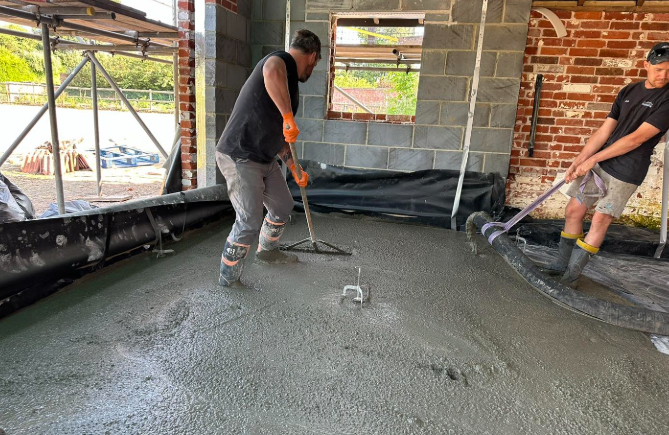
Traditional screed is a site-mixed material that requires skilled labour for mixing and installation. It typically takes around 21-28 days to dry sufficiently for light foot traffic and significantly longer before floor coverings can be laid. A key drawback is its susceptibility to cracking and curling. It is also difficult to lay traditional screed that is free of voids, or air pockets which can create cold spots in the heat distribution.

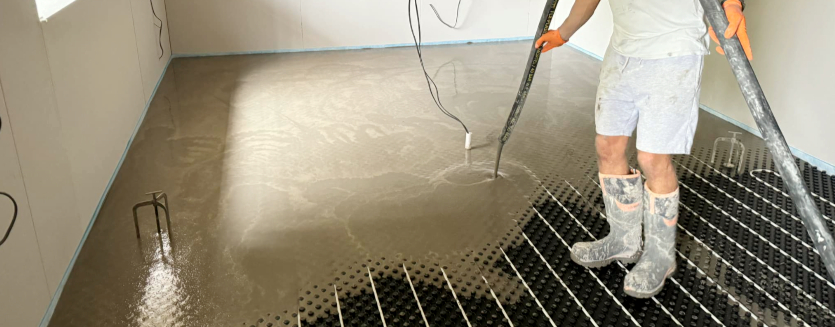
Liquid screed, on the other hand, is a pre-mixed, free-flowing material that self-levels, creating a perfectly smooth surface. It dries much faster than traditional screed, often being walkable within 24-48 hours and ready for floor coverings in a shorter time frame depending on the depth and environmental conditions.
Its efficient thermal conductivity and resistance to shrinkage make it ideal for UFH systems.
What Thickness Should Screed Over Underfloor Heating Be?
The ideal screed thickness over underfloor heating depends on factors such as the type of screed used, and the required response time of the heating system. The following guidelines can only be general, therefore:
Traditional Sand and Cement Screed:
- For water-based UFH systems, a minimum thickness of 65mm – 75mm is generally recommended. This gives sufficient coverage of the pipes and offers the thermal mass required for heat retention.
Liquid (Flowing) Screed:
- Liquid screed offers greater flexibility due to its higher thermal conductivity. For water-based UFH, a minimum thickness of 50-55mm is recommended. In some cases, depending on pipe diameter and spacing, this can be reduced slightly, but we would advise you talk to a screed specialist like Buxton Flow Screeds before committing to a thinner layer of screed.
We’ve suggested minimum thicknesses. Increasing the screed thickness will increase the thermal mass of the floor, resulting in slower heat-up and cool-down times but more stable temperatures. If you reduce the thickness (in safe limits) it will result in faster response times but less stable temperatures.
Expert Screeding for Underfloor Heated Floors
Buxton Flow Screeds has teams of UFH screeders local to you, who can manage every stage of the screeding process. From our initial site visit to the final quality checks we carry out, our screeders make ongoing adjustments in order to be sure of a flawless, high performance screed floor.
Ready to create the perfect foundation for your underfloor heating system? Contact Buxton Flow Screeds today for a free consultation and expert advice – 020 3369 3396 / 07590 625100


