
Can You Use Microcement on Floors?
Can You Put Microcement Over Your Existing Floor? What You Need to Know Before Starting
Can you use microcement on floors? Yes, you can, so long as you don’t confuse microcement with a simple coat of floor paint. It’s a highly engineered, multi-layered architectural finish and, while it delivers the smooth, minimalist look of polished concrete, it behaves entirely differently on-site. In this blog we’ll take you through how microcement performs on domestic and commercial floors, and offer some guidance on how to tell if your substrate can take it.
Why trust us? At Buxton Flow Screeds, we’ve spent the last two decades supplying and installing liquid screed applications. Now, as approved Forcrete installers, we combine our 20 years of structural flooring expertise with specialist microcement installation, guaranteeing that your new floor isn’t just beautiful – it’s built to last.
What is Microcement?
The most impressive advantage offered by microcement is its minimal floor buildup. It delivers a seamless, joint-free finish without stealing your room’s headroom or forcing structural modifications.
Microcement packs high compressive strength into a 3.5mm gauge, so you get flooring that looks like it’s solid concrete without any structural reinforcement or messy modifications to your existing joinery.

Where Microcement Flooring Works – And Where it Doesn’t
Because microcement finishes at just 3mm thick, it has no structural strength of its own; instead it relies entirely on the stability of the floor beneath it. If your sub-floor flexes, bounces, or shifts, the microcement layer will crack.
Substrate preparation is where microcement projects succeed or fail. The base must be rigid, clean, and entirely free of movement. Any existing cracks in the sub-floor must be stitched with resin anchors before work begins. If your current base is uneven or unstable, it must be corrected first with a high-strength levelling compound.
Applying Microcement Over Timber Flooring
This is entirely possible, but only if you completely eliminate any deflection. The Buxton team achieves this by mechanically fixing the timber, overlaying it with rigid cement particle boards, and embedding a structural fibreglass mesh into an epoxy primer to absorb any minor structural movement.
Applying Microcement Over Old Tiles
A microcement floor acts as a mirror to the substrate underneath. If you install it over old tiles without proper preparation, the pattern of the underlying grout lines will eventually ‘telegraph’ through to the finished surface.
To stop this, the existing floor needs to be mechanically ground back to create a key, and a high-solid epoxy scratch coat must be applied to create a perfectly flat, unyielding base before the first microcement layer is trowelled.
Underfloor Heating, Curing & Moisture Control
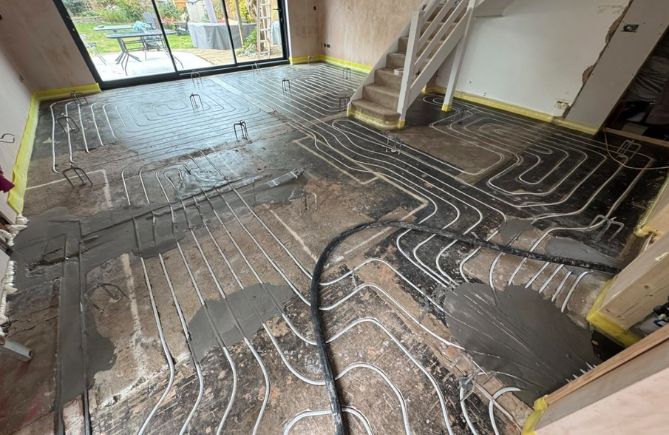
Microcement pairs exceptionally well with underfloor heating (UFH) because its thin profile allows heat to transfer into the room almost instantly. The installation sequence must be precise for optimal results, though.
If you are trowelling over a new liquid flow screed or self-levelling compound, you need to allow the substrate to fully cure first. Only after the compound has completely cured can you perform the UFH commissioning cycle – gradually raising the system to its maximum temperature to force any residual expansion and moisture out.
The underfloor heating system must complete a full thermal commissioning cycle after the base compounds have fully cured but before applying microcement.
The reason for this? This process triggers any natural settling cracks early, allowing us to repair them before they can affect the look of your final flooring.
Why Microcement Installation is a Job for the Pros
A finished microcement floor looks seamless and effortlessly smooth, but don’t let that fool you. Achieving that look requires a precise, manual process.
Application By Hand
Microcement isn’t poured like a liquid screed, nor is it rolled on like industrial paint. It’s applied by hand using specialised steel trowels. Every movement of the blade creates the subtle texture and tonal variation, often called marbling – that gives the floor its unique architectural character.
Multi-Stage Process
The multi-stage application process is completely unforgiving; it leaves you no margin for error. A single speck of dust in the base coat or an uneven stroke during the final top coat will ruin the finish. Installation includes managing drying times between layers, monitoring site humidity, and carrying out careful sanding between coats.
Tight Workability Window
The material has to be worked quickly before it begins to set on the trowel and because each coat is under 1.5mm thick, you must maintain uniform pressure across the entire floor to prevent ridges or thin spots.
This is why successful installations rely on trained and approved microcement specialists who understand the chemical demands and limitations of the product.
Wet Rooms & Open-Plan Zones – The Forcrete Benefits
Seamless floors look incredible in open-plan layouts, wet rooms, showers and bathrooms. And the built-in benefit of using Forcrete microcement is that it’s completely waterproof through every single layer.
Here is how this system performs across high-traffic and wet zones:

- Walk-In Showers & Fully Tanked Wet Rooms – Because it lacks grout lines, there is nowhere for mould to grow or water to pool. Even under constant water pressure, the layers remain completely waterproof.
- Open-Plan Kitchens – Microcement eliminates the joint lines where crumbs, grease, and bacteria typically hide. You get a continuous, highly hygienic surface that is easy to mop clean.
- Integrated Fixtures – Because it is applied by hand, we can run the material seamlessly up over sink units, bath surrounds, and onto walls, creating a completely sealed, tanked environment.
- High-Traffic Living Spaces – It’s engineered to resist the chemical staining of daily life, so spilled glass of red wine, dropped cooking oil, or muddy boots are not a problem.
Microcement Floor Management FAQs
Clients usually want to know about the durability of microcement flooring. Here are the questions our Forcrete approved installers get asked most regularly.
How long after the installation can the floor handle foot traffic?
You’ll need to wait 24-to-48-hours before you can walk on the floor. Please note that the chemical curing process takes a full 7 days to reach maximum structural hardness, though. Other trades must be kept away from the area during this time, and any heavy furniture placement or appliance installation should wait until day 8 to prevent deep tracking or marking.
Is a microcement floor slippery when wet?
No more than standard matte porcelain tiles. We control the slip resistance during the final trowel stages and sealer selection. By introducing microscopic quartz slip-retardant aggregates into the polyurethane lacquer, we can achieve an R10 or R11 rating, making it completely safe for walk-in showers and wet kitchen zones without losing the smooth visual finish.
Can a scratched or gouged microcement floor be repaired?
Yes. If a heavy object gouges the surface, we patch the specific area using the original batch pigments and hand-burnish the repair into the surrounding floor. The polyurethane sealer can also be lightly sanded back and reapplied to erase surface scuffs.
How many years will the surface lacquer last before it needs resealing?
In a standard domestic setting, your top sealer coat has a lifespan of 5 to 7 years before it shows wear in high-traffic areas like kitchen sinks or main doorways. Resealing doesn’t mean ripping the floor up; it involves a mechanical deep clean, a light orbital sand to key the surface, and the application of two fresh coats of polyurethane lacquer.
The Verdict – Is Microcement Right for Your Floor?
As we have seen, the installation requires precision, patience, and – crucially – a deep understanding of the floor beneath. At Buxton Flow Screeds, we don’t just apply a finish – we engineer the floor from the substrate up. By combining our 20 years of screeding experience with the superior technology of Forcrete, we make sure that your new floor is as strong and flawless as it is good looking.
Ready to Transform Your Home?
Don’t leave your dream floor to chance. If you have a renovation project in mind and want to discuss options, substrates, or colours, our team is here to help – 020 3369 3396/07590 625100


