
What is Screed Flooring?
Liquid Screed and Floor Levelling – A Guide for Builders, Renovators, and Self-Builders
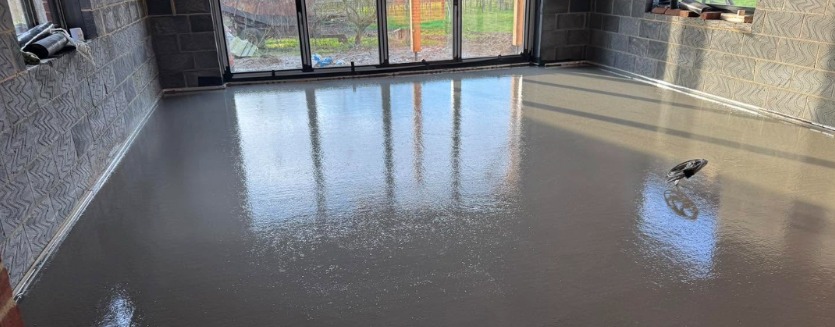
What is screed flooring? It’s a smooth, level layer of material – traditionally sand and cement or modern liquid flowing compounds – which is applied directly over a concrete structural base to create a perfectly flat surface for final floor coverings.
At Buxton Flow Screeds, we’ve spent over 20 years supplying and pouring high-performance liquid screed across the UK. If you’re a main contractor managing a commercial build, a self-builder installing underfloor heating, or an experienced DIYer tackling an extension, getting this layer right is what guarantees that flawless finish which lasts decades without cracking.
What Is Liquid Screed Made Of?
Liquid screed is an engineered fluid compound made of synthetic calcium sulphate binder, calibrated fine aggregates, water, and chemical flow-control polymers.
By replacing standard Portland cement with an anhydrite binder, the mix avoids the high shrinkage rates typical of traditional semi-dry 4:1 sand-and-cement beds. The exact material composition delivers specific on-site performance characteristics:
- Recycled Calcium Sulphate Binder – Minimises internal curing strain, allowing contractors to pour up to 1,000 square metres in a single day without requiring intermediate expansion joints.
- 0–4mm Sharp Sand Aggregate – Provides structural stability and a smooth, self-levelling SR2 surface finish that reduces the need for expensive self-levelling compounds later.
- Superplasticiser Admixtures – Drives high fluidity at a low water-to-binder ratio, ensuring the floor achieves walkability within 24 to 48 hours while producing a final subfloor with high compressive strength (typically C25 to C30).
Why You Can’t Use Concrete as a Final Leveling Layer
Trying to get a subfloor perfectly flat using standard concrete doesn’t work. For the simple reason that concrete contains large stones, which means it can’t be feathered down or smoothed out.
If you try to skip the screed stage, you run into three immediate problems:
- Uneven Tile Beds – Your tiler will waste your budget on extra adhesive trying to compensate for dips in the raw slab.
- Hollow Spots – Engineered wood floors will flex and creak over voids.
- Failed Warranties – Flooring manufacturers will void their warranties if the subfloor doesn’t meet strict flatness tolerances. Under British Standard BS 8204, subfloor flatness is strictly graded, with premium thin vinyls, laminates, and large-format tiles requiring a high-precision SR1 finish (a maximum 3mm vertical deviation over a 2-metre span).
Structural concrete is designed under BS EN 206 for load-bearing strength, using coarse aggregates exceeding 20mm. This makes it physically impossible to feather down or smooth out to SR1 accuracy.
Traditional Sand and Cement vs. Modern Flowing Screed
For decades, traditional sand and cement screed was the only way to go. It’s a dry, stiff mix that is spread with a shovel and straightedge. If space is tight and the area is tiny, it remains an excellent fallback.
But for modern extensions and new builds, liquid flow screed offers a much better performance. Here is how the site realities compare:
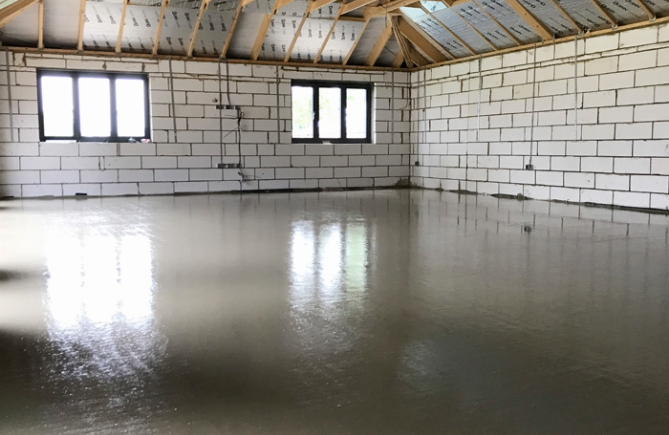
- Manual vs. Pumped – Traditional screed needs days of physical tamping. Liquid screed arrives ready-mixed and is pumped through a flexible hose, covering a 150m² house in less than three hours.
- Compaction Issues – Stiff traditional mixes are prone to human error, often leaving hidden internal air pockets. Liquid screed flows like water, self-compacting around pipes and insulation to form a solid, void-free mass.
Why ‘Looks Flat’ Isn’t Flat Enough
The biggest trap for self-builders and DIYers is putting their trust in a visual inspection. A floor can look perfectly level across a room, yet still contain rolling waves that will ruin a final floor installation.
Standard sand and cement screeds installed by hand rarely beat an SR2 finish (+/- 5mm deviation). That 5mm dip causes 3 immediate problems for modern floor coverings:
- Tile Lippage – With large tiles, a 5mm drop means the edge of one tile will sit higher than the one next to it, which creates an ugly surface flaw and dangerous trip hazard.
- Hollow Echoes – Hardwood flooring laid over dips will leave pockets of trapped air underneath, causing a hollow sound when walked on.
- Adhesive Failure – Glued-down floors will pull away from the screed as the planks attempt to flatten out, snapping the adhesive bond completely.
Switching the project specification to a flowing liquid screed solves this. It flows across the floor like water, self-levelling under its own weight to achieve an SR1 standard (under 3mm deviation) across the entire floor plan.
Why Your Underfloor Heating Needs Liquid Screed to Work Properly
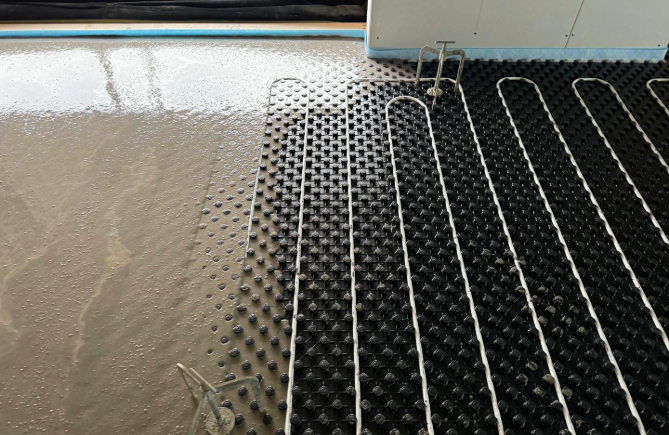
If you’re installing a wet underfloor heating system, the material you pour over the pipes will determine how well your heating works, and how much the UFH will cost to run. Traditional sand and cement is an unreliable partner for UFH, and here’s why:
- Eliminating the Air Pockets – Traditional screed is stiff and dry. When you shovel it around UFH pipes, it leaves tiny air pockets underneath the pipe curves. Because air is an insulator, those pockets block heat from rising into your room. Liquid flowing screed completely wraps around the pipes with no voids.
- Doubling Your Heat Conductivity – Liquid calcium sulfate screed has a thermal conductivity value of roughly 2.2 W/mK (Watts per metre-Kelvin), compared to just 1.1 W/mK for traditional sand and cement. So, the heat moves through liquid screed twice as fast.
- Lowering Boiler Temperatures – Because the thermal transfer is so efficient, you can drop your heat pump or boiler flow temperatures by several degrees. That tweak will save money on energy bills every single month.
What is Laitance? And Why is it Important You Know?
Liquid calcium sulfate (anhydrite) screeds form a weak, shiny crust on the surface as they cure. This crust is called laitance.
If you try to stick your tiles or engineered wood straight onto it, the adhesive will bond beautifully to the laitance, but the laitance will peel straight off the solid floor underneath. The tiles will tent, crack, and lift within a few months. Check out our guide to successful laitance removal.
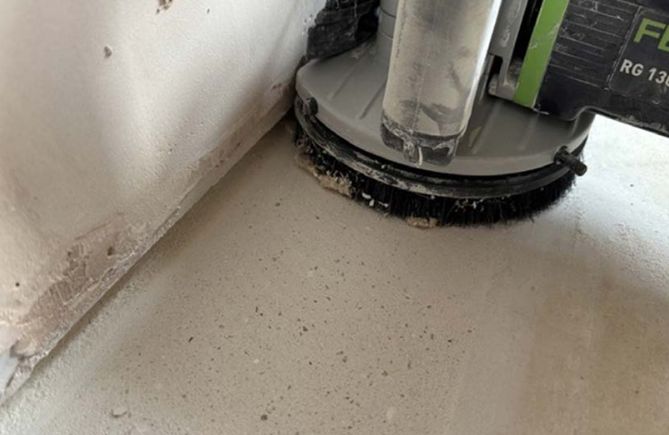
- The 7-to-11-Day Window – You must not leave laitance on the floor. It must be mechanically sanded off between 7 and 11 days after the pour.
- Why the Timing Matters – At this stage, the screed is cured enough to walk on but soft enough that a rotary sanding machine can easily scarify the crust away. If you leave it a month, say, it will have turned to granite, needing diamond grinding to remove it.
The Cementitious Alternative – Eliminating Laitance
Specifying a cement-based liquid screed (such as a Cemfloor mix) completely bypasses the laitance issue by replacing the calcium sulphate binder with a specialised Portland cement matrix.
Because this compound cures using standard cement hydration rather than forming a crystalline gypsum crust, it does not force a weak, dusty layer to the surface during drying.
This eliminates the post-pour mechanical sanding phase entirely. It also streamlines your tiling schedule, as the dry subfloor is directly compatible with standard C2-classified cementitious tile adhesives without requiring the intensive, specialised primers needed to prevent adhesive failure on anhydrite beds.
Liquid Screed FAQs – What We’re Asked On-Site
After 20 years of pumping screed across the UK, we tend to hear very similar questions from clients every week. Homeowners want to know about timelines, and builders want to know about trade handovers. Here are the answers to the ones we get asked most regularly.
When can the other trades get back into the house after you pour?
You can walk on our flowing liquid screed within 24 to 48 hours. We recommend keeping the windows closed for the first 24 hours to let it cure naturally, but after 48 hours, you can open them up to let the moisture out. Your bricklayers, electricians, and plumbers can get right back to work, but no heavy rolling loads (like scaffolding towers) for at least a week.
How long do I have to wait before laying my tiles or wood?
The rule for liquid screed drying is 1mm per day for the first 40mm of depth. If we pour a 50mm floor, the first 40mm takes 40 days, and the remaining 10mm dries at roughly 0.5mm per day, taking another 20 days. That’s about 60 days total.
If you’re up against a tight deadline, you can start force-drying the slab from day 7. Commission the underfloor heating at a low flow temperature of 15°C, increase it by 5°C a day, and bring in commercial dehumidifiers to extract any moisture in the air.
Do I really need to pay for sanding the laitance, or is that just an optional extra?
It is not optional. If anyone tells you that you can skip sanding the laitance skin off an anhydrite floor, don’t trust them with your project. If you don’t sand it within 7 to 11 days, your tile adhesive or floor primer will stick to that loose surface crust instead of the solid slab. Your expensive floor finish will eventually lift and crack.
What happens if it rains right after you finish pouring?
The building must be completely watertight before we pump. If heavy rain hits a freshly poured liquid floor before it has skinned over, the impact of the water droplets will ruin the surface finish, pit the material, and dilute the binder, destroying the structural strength of the top layer. Keep the roof on and the windows in before booking your pour.
Ready to Get Your Subfloor In?
Don’t risk your final floor finish on. Get in touch with the Buxton Flow Screed team today for a free, no obligation conversation about your next project. We’ll give you a precise quote based on 20 years of active site experience.
Get in touch today for a free, no-obligation quote on your next project – 020 3369 3396/07590 625100


