
Why Have Underfloor Heating Versus Radiators?
Is Underfloor Heating a Better Choice Than Radiators?
If you’re wondering ‘why have underfloor heating versus radiators?’ your choice really comes down to the kind of warmth you want. Radiators heat the air, creating convection currents that can lead to warm ceilings and cooler floors. Underfloor heating (UFH), however, uses radiant heat, which gently and evenly warms objects and people in the room from the ground up—much like the sun’s warmth.
This fundamental difference affects not just your comfort, but also your home’s efficiency and your interior design freedom. In this blog we’ll help you to decide which is right for you.
Working with homeowners to create comfortable, efficient spaces is what we do best. For more than 20 years, the team at Buxton Flow Screeds has specialised in underfloor heating installation. We’re not just installers though, we’re heating professionals who care about you understanding your options, so you can choose the right solution for your home.
Radiant Warmth – It’s Like Standing in Gentle Sunshine
Most likely you already know what radiator heat feels like – often you get a blast of warmth when you’re close to it but find it’s chilly when you’re at a distance. You may also have experienced a stuffy feeling as dust and air circulates. Radiant heat from an underfloor system solves these issues.
Instead of heating the air, it turns your entire floor into one large radiator. The warmth it generates travels upwards, heating you and your furniture directly. The result is a consistent, comfortable temperature from wall to wall, with no cold spots on the floor and no overheating at head height. Radiant heat feels very luxurious, especially on your feet.
How Underfloor Heating Works – A Simple Guide
A radiator’s job is to make the air in a room hot. An underfloor heating system’s job is to make the room comfortable. It’s a subtle but important difference in approach. Rather than concentrating intense heat in one place, UFH distributes gentle warmth invisibly across your whole floor area. This is how it creates an all-encompassing comfort.
‘Wet Underfloor Heating’ Explained
This guide explains our most popular system, which uses warm water.
- Step 1 – The Heat Source: Your existing boiler or heat pump gently heats water to a much lower temperature than it would for radiators (35-50°C).
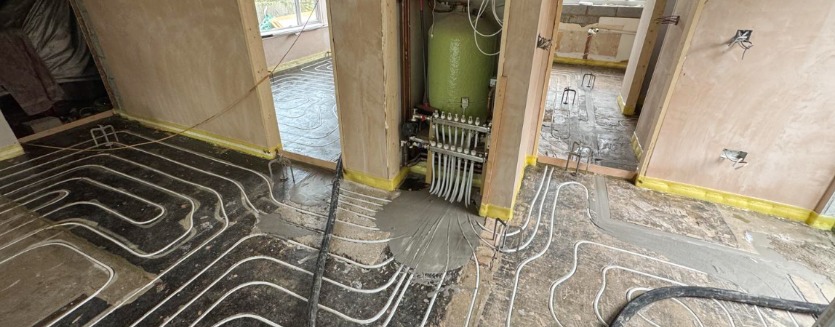
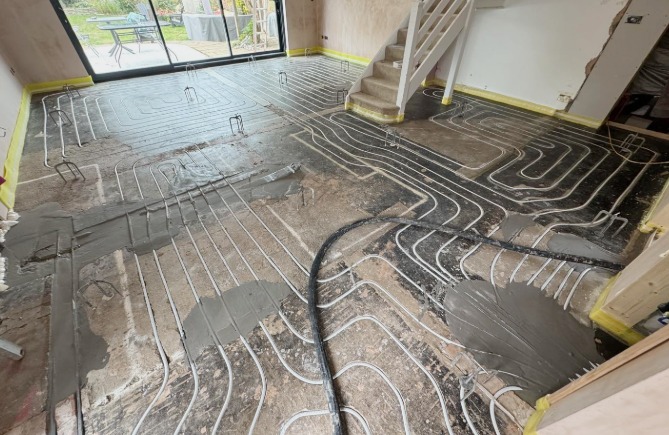
- Step 2 – The Pipe Network: This warm water flows from a manifold (the system’s control centre) through a continuous loop of pipe laid out in a specific pattern under your floor.
- Step 3 – The Radiant Surface: As the water circulates, the pipes transfer their warmth to the surrounding flow screed and your floor finish, turning the entire surface into a mild, room-sized radiator.
- Step 4 – Gentle, Even Heat: The floor then radiates this warmth upwards, heating people and objects directly to create a consistent, comfortable temperature throughout the room.
Underfloor Heating vs Radiators – Which is Cheaper to Run?
While installing underfloor heating will cost you more than installing radiators, the real efficiency is to be found in the day-to-day running costs. It’s here that UFH offers significant savings.
A radiator needs to get very hot (60-75°C) to push enough convection heat into a room. By contrast, wet underfloor heating systems run at a much lower, more efficient temperature of around 35-50°C. Because your boiler or heat pump doesn’t have to work as hard, it uses less energy. This efficiency gain means a UFH system can be around 25% cheaper to run than radiators with a modern boiler, and up to 40% cheaper when paired with a heat pump.
Your Underfloor Heating Questions Answered
When you’re considering a new type of heating system, you’re going to have lots of questions. To help, we’ve selected answers to some of questions we get asked regularly. If your question isn’t covered here, the Buxton Flow Screeds team is always happy to offer advice or guidance.
1. Do I have to dig up my concrete floor to install UFH?
Probably not. For new builds or extensions, the pipes are laid before the concrete or screed is poured. If you want to retrofit UFH in an older property, we can use slim, low-profile panels that sit on top of your current floor, adding very little height and avoiding disruptive building work.
2. Are there any health benefits compared to radiators?
There are. Radiators heat by convection, which creates air currents that circulate dust, pollen, and other allergens around the room. Underfloor heating uses radiant heat which doesn’t cause air movement. This creates a healthier environment, especially for people with allergies or asthma.
3. What happens if a pipe leaks under the floor?
It’s unlikely that this would happen. The pipe we use is a single, continuous length with no hidden joints, which is the main cause of leaks. The entire system is pressure-tested before the screed and flooring are laid to guarantee its integrity. In the unlikely event of a leak, it can be located and repaired.
4. How long does an underfloor heating system last?
A professionally installed wet underfloor heating system is built to last. The high-quality pipes have a design life of over 50 years and are often guaranteed for this period. The system should last for the lifetime of the building, making it a reliable, long-term investment for your property.
Is It Time to Say Goodbye to Radiators?
Ultimately, your choice comes down to the kind of living space you want to create. Radiators heat a room, but underfloor heating makes it a place people can relax in. The consistent radiant warmth creates a more luxurious and comfortable environment that is also cheaper to run long-term. And don’t forget, without bulky radiators on the walls, you have a blank canvas to create the kind of interior you’ve always wanted.
Ready to feel the difference for yourself? If you have questions or would like to chat about your project, our friendly team is here to help. Give us a call today for a no-obligation chat – 020 3369 3396 or 07590 625100.


