
What the Best Screed for Underfloor Heating?
Which Screed Works Best For UFH?
What’s the best screed for underfloor heating? Liquid anhydrite and liquid cementitious screeds are the top choices. Both flow around the heating pipes, eradicating thermal air pockets, and achieving thermal conductivity up to 2.2 W/mK compared to traditional sand-and-cement’s 1.1 W/mK.
Anhydrite allows thinner coverage (minimum 25mm cover over pipes), while cementitious liquid screed dries faster, requires no mechanical laitance sanding, and handles wet rooms without any moisture breakdown.
Two decades of pumping liquid screed on site has taught the Buxton Flow Screed team one thing – no single product fits every underfloor heating job. While liquid anhydrite screed delivers excellent thermal output and lower build heights across large floors, cementitious mixes are what you need for wet rooms or when site deadlines demand faster curing. Below we look at both options so you pick the right spec for your build.
Why Anhydrite Screed is the Best Screed for Underfloor Heating Installation
Thermal conductivity is what determines how quickly your heating system warms the room and how much energy the heat pump or boiler uses up. Traditional sand-and-cement screed operates at roughly 1.1 W/mK. This is because its manual application leaves small air gaps around the heating pipes. The trapped air acts as an insulator, keeping heat inside the slab instead of transferring it into the room.

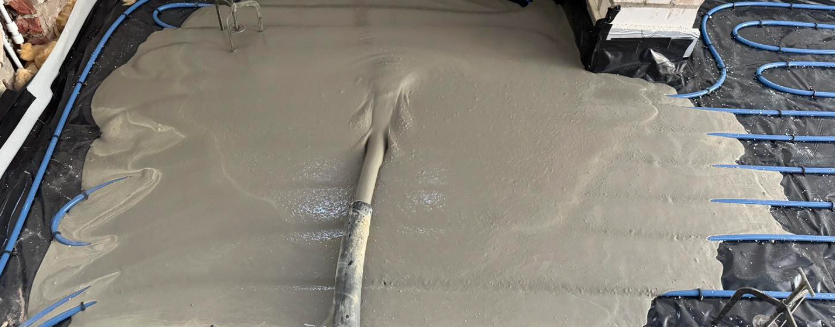
Liquid screeds reverse this situation. Poured as a flowable liquid, both anhydrite and liquid cementitious mixes encapsulate the pipework completely with no air voids whatsoever. Liquid anhydrite reaches a thermal conductivity of 1.9 to 2.2 W/mK, transferring heat twice as fast as dry-mix screed. Liquid cementitious screeds deliver a close 1.9 to 2.0 W/mK. Higher conductivity means lower flow temperatures from your heat source, directly cutting operating costs.
Performance & Specification Table
Metric | Liquid Anhydrite Screed | Liquid Cementitious Screed | Traditional Sand & Cement |
Thermal Conductivity | High (1.9 – 2.2W/mK) | High (1.9 – 2.0W/mK) | Low (1.1W/mK) |
Min. Depth Over UFH Pipes | 25mm (45mm-50mm total) | 30mm (50mm total) | 40mm(65mm – 75total) |
Laitance Sanding Needed? | Yes (7–14 days post-pour) | No | No |
Wet Room / Bathroom Fit | Requires full tanking membrane | Very good (water resistant – requires waterproofing) | Good |
UFH Commissioning Start | Day 7 | Day 7– |
Drying Schedules, Laitance Sanding, and UFH Heat Commissioning
The amount of moisture in your slab dictates when you can lay tiles, luxury vinyl, or engineered wood.
- Anhydrite screeds – these need to be sanded to remove laitance at the 7-to-10-day mark. Skipping this step traps moisture inside the slab and causes tile adhesives to debond further down the line.
- Liquid cementitious screeds – drying is predictable and laitance doesn’t form so mechanical sanding isn’t required.
Forcing out deep slab moisture requires a schedule before final floor fitting:
- Start Low (Day 7) – Fire up the UFH manifold at a low 20°C flow temperature.
- Step Up Daily – Increase system water temperature by 5°C per day over 5 days.
- Peak Heat Hold – Maintain maximum design temperature for 3 full days to drive out all residual vapour.
- Controlled Step-Down – Ramp down by 5°C per day back to baseline.
- Final Moisture Check – Test slab relative humidity with a moisture meter or carbide hygrometer before laying floor coverings.
Subfloor Preparation, Minimum Build Depths, and Pipe Encapsulation
You need a tight, sealed subfloor base to encapsulate the heating pipes. Clip the UFH pipework firmly to insulation boards at 500mm intervals. Any poorly secured pipe will float to the surface during the pour.
Run perimeter edge expansion foam along every wall and structural column to absorb thermal expansion and stop any cold bridging from the subfloor.
Once the pipe network is pressure-tested and filled with water (helping to prevent pipe buoyancy during the pour), the liquid screed is pumped over the subfloor. A liquid depth of 45mm–50mm provides full structural encapsulation.
This thin profile warms up in under 30 minutes, compared to the 2–3 hours required to push heat through a thick 75mm traditional sand-and-cement slab.
Underfloor Heating Screed – FAQs
Got questions about how liquid screed performs once the pour is finished? Here are answers to the questions we get asked regularly on site.
Do I need to put expansion joints in my liquid screed floor?
Yes. Liquid anhydrite screed needs expansion joints in continuous areas over 300m² or along floor runs exceeding 20 metres. You should also install movement joints across doorway thresholds, between independently controlled heating zones, and in rooms with an aspect ratio greater than 1:2 (e.g., long corridors). These joints allow the slab to expand and contract naturally as the heating pipes warm up, preventing stress cracks across tiled or resin finishes.
Can I glue engineered wood or LVT straight onto cured liquid screed?
No. The surface needs to be prepped first. Once the slab is dry and laitance is removed, apply an acrylic or polyurethane primer. This seals the screed’s porous surface and stops the screed from sucking moisture out of the adhesive too quickly. For timber or LVT, use a flexible, high-grab adhesive rated for underfloor heating to absorb thermal movement without losing bond strength.
Is liquid screed too heavy for timber upper-floor joists?
Usually it is. For upper floors, structural engineers usually specify either engineered metal-web I-joists designed for the dead load, or a low-profile liquid overlay system poured over high-density insulation at a reduced depth of 25mm to 30mm.
What if I don’t have depth for a 50mm screed pour on a renovation?
You can install low-profile, ultra-thin liquid screeds or cementitious levelling compounds over castellated UFH trays or micro-pipe systems. These specialised mixes achieve full structural strength at depths as thin as 15mm to 20mm total, allowing you to retrofit underfloor heating without altering door heights.
Book Your Buxton Flow Screeds Installation
From subfloor prep checks to heat commissioning support, we deliver high-performance liquid screed and cementitious screed across the UK.
Speak to an installation specialist today on 020 3369 3396 / 07590 625100 or get a free quick quote.


