
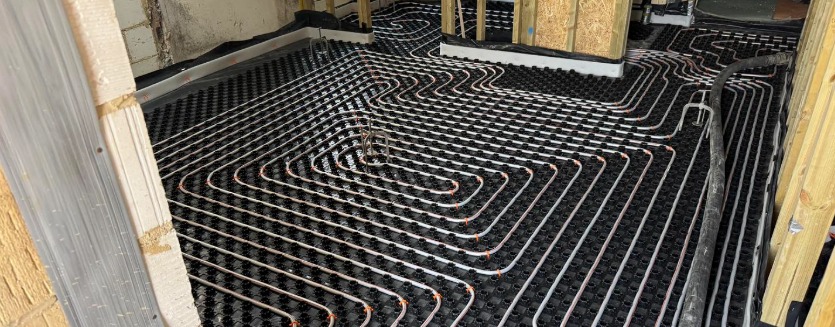
What is The Best Flooring For Underfloor Heating?
How to Maximise Your UFH System’s Efficiency
If your goal is an energy-efficient home, ‘what is the best flooring for underfloor heating?’ is the question you ask once your thermal efficient foundation is in place. The liquid screed which encases your underfloor heating pipes is what actually dictates your system’s performance. Get that right and any flooring you choose will work much better for your home.
Because liquid screed has high thermal conductivity, it allows heat to pass through to your floor surface with minimal resistance. It’s the engine that powers your flooring, providing the efficiency required to make your UFH investment pay off.
Experience is the best teacher, and with twenty years in the industry, Buxton Flow Screeds has mastered the art of efficient heating. As specialist installers of UFH systems using liquid screed, we have a thorough understanding of how these components work together. Our team provides the informed, direct advice you need to ensure your flooring choice performs beautifully, backed by two decades of UK installations.
What is The Best Flooring For Underfloor Heating?
While the liquid screed provides the perfect thermal foundation, your choice of top-floor finish determines how that heat is distributed throughout your home. You’re looking for a balance between the interior style of your home and the thermal conductivity the system requires.
The good news is that modern manufacturing means almost any material can be compatible, provided you understand the technical “sweet spots” for each.
Stone and Ceramic Tiles
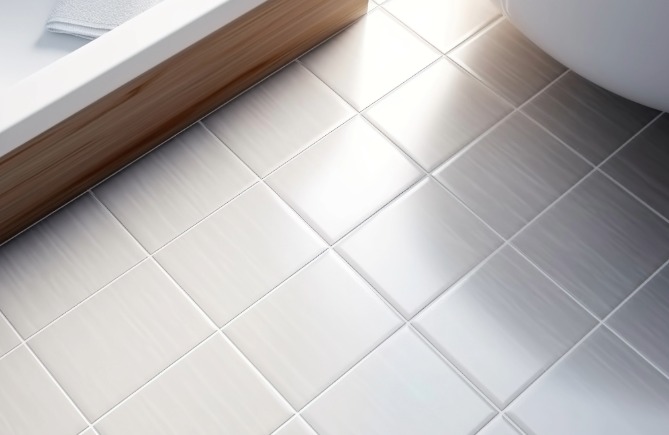
These remain the absolute “best in class” for underfloor heating. Tiles and natural stone (like limestone or slate) have high thermal conductivity, meaning they heat up quickly and retain that warmth as a “thermal mass.” When paired with liquid screed, they create the most responsive and energy-efficient system possible.
Engineered Wood Flooring
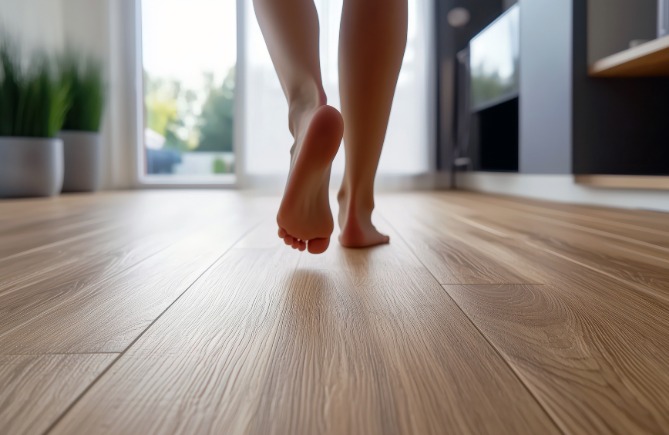
If you want the look of timber, engineered wood is significantly better than solid wood. It is constructed in layers, making it stable enough to handle the expansion and contraction caused by temperature changes. For the best heat transfer, we recommend a board thickness of 15mm or less and ensuring the wood is dense.
Luxury Vinyl Tile (LVT) and Linoleum
LVT has become a top choice for DIYers because of its durability. Both vinyl and lino are excellent conductors. They are, however, sensitive to heat; most manufacturers specify a maximum floor temperature of 27°C. Our installers always recommend using a floor sensor to ensure the system stays within these safety limits to prevent the floor from softening or discolouring.
Modern Rubber Flooring
Rubber is gaining popularity in modern renovations for its soft feel and high conductivity. It behaves similarly to vinyl, heating up very quickly. It also shares the 27°C temperature cap. It’s a fantastic, hard-wearing option for playrooms or home gyms where liquid screed is used.
Carpet and Underlay
You can certainly use carpet, but it acts as an insulator. To prevent the heat from being “trapped” under the floor, the combined Tog rating of your carpet and underlay should ideally not exceed 2.5 (though for modern air-source heat pump systems, we often suggest aiming for 1.5 to 2.0 for better efficiency). Always check the manufacturer’s “UFH-ready” certification.
Microcement
If you’re looking for a seamless, modern finish, microcement is proving an excellent partner for UFH. Because it is applied in incredibly thin layers (usually just 2-3mm), there is almost zero thermal resistance. Heat from your liquid screed travels almost instantly to the surface, making it one of the most responsive and energy-efficient options available today.

Don’t Skip These Steps – Preparing Your UFH System for Flooring
The transition from a fresh liquid screed to a beautiful, finished floor is the most critical phase of your project. There are a few essential steps every renovator and self-builder should follow before the first tile or plank is laid.
- Commission Your Heating – Never lay flooring on a “cold” system that hasn’t been run. Your UFH must go through a full thermal cycle to allow the liquid screed to expand and contract.
- Check Moisture Levels – Even if the surface looks dry, we always recommend a professional hygrometer test. Different flooring types have strict moisture tolerances (usually <75% Relative Humidity).
- Surface Preparation: Depending on the screed type, a light sanding may be required to remove “laitance” (a thin surface film) to ensure your floor adhesive bonds perfectly.
- Clear the Dust – After sanding, the floor needs to be vacuumed thoroughly. Any leftover grit can interfere with the thermal bridge between the screed and your flooring.
- Prime the Surface – Always use a primer recommended by your adhesive manufacturer to seal the screed and provide the best possible “key” for the final finish.
Floor Finishes for UFH – FAQs
Here are some of the questions we get asked most regularly when installing underfloor heating:
How do I know if my screed is dry enough for flooring?
Even after twenty years, we never guess. We recommend a hygrometer test to ensure the Relative Humidity (RH) is below 75% before any moisture-sensitive flooring is laid.
Can I use solid oak flooring with UFH?
We would advise against solid hardwoods as they can warp. If, however, that’s the finish you want, you’ll get the best results if you ensure it’s kiln-dried and the system is commissioned slowly.
What happens if the floor gets hotter than 27°C?
For materials like vinyl or laminate, exceeding this can cause the adhesive to fail or the material to discolour. A well-installed system by Buxton Flow Screeds will include the necessary limiters to prevent this.
Is rubber flooring a good choice for kitchens?
Yes! It’s highly conductive, durable, and very comfortable underfoot. When laid over a level liquid screed, it’s a brilliant, modern UFH-ready solution.
How Buxton Flow Screeds Can Help
Choosing the best flooring for your underfloor heating is about creating a home that is as efficient as it is beautiful. By starting with a high-performance liquid screed foundation and following our guide to material compatibility, you can be sure that every watt of heat is used effectively.
Ready to lay the perfect foundation for your home? At Buxton Flow Screeds, we bring over two decades of expertise to every project, providing precision liquid screed and professional UFH installation across the UK.
Call us today on 020 3369 3396 / 07590 625100 to talk to our UFH about how we can support your flooring project.
Need a FREE quick quote or to get in touch?
Fast-Tracking Your Commercial Fit-Out
In a commercial renovation, time is money. Any delay in the flooring schedule will holds up the joiners, the decorators, and ultimately, the incoming users. This is where liquid screed demonstrates its superiority to all other solutions.
The Installation
With liquid screed, Buxton Flow Screeds can pump the entire floor of an office conversion in just a few hours using a single hose.
The Return to Service
Liquid screed allows foot traffic within 24 to 48 hours. Electricians and plasterers can get back in to finish the fit-out days, or even weeks, ahead of schedule.
Rapid Drying Screeds
On a tight deadline? Rapid drying screeds are ready to final finishing after just 7 days allowing you to move onto the next stage in super-quick time.
Frequently Asked Questions About Commercial Screeding
Getting the pour right is our job but helping you understand what happens next is part of our service. Here are the most common questions we get from site managers regarding the finishing stages.
1. Do I need to sand the floor before laying vinyl or carpet tiles?
Yes. As liquid screed dries, it pushes a fine layer of ‘laitance’ (weak surface skin) to the top. To guarantee that your commercial floor adhesives bond perfectly, this skin should be lightly sanded or buffed away 7-10 days after application. This reveals the strong, solid aggregate underneath.
2. How soon can I turn on the Underfloor Heating (UFH)?
You can usually introduce heat after 7 days, but it must be done gradually. We recommend starting at a low flow temperature and increasing it by 3-5°C per day. This “commissioning” process helps drive out moisture deep in the screed without “shocking” the floor.
3. Can liquid screed improve the acoustic performance of an office?
Yes, because liquid screed is denser than traditional screed and wraps tightly around floating floor insulation, so it acts as a sound deadener, reducing impact noise transmission to the office below.
Choose Buxton Flow Screeds for Your Commercial Project
Renovating a historic building is a balancing act between preserving the past and building for present day occupants. You need a floor that respects the old structure while delivering the performance needed in a modern office.
At Buxton Flow Screeds, we provide a proven pathway to a problem-free fit-out. With over 20 years of experience in commercial renovations, we have the technical know-how to turn even the most uneven, challenging subfloors into flawless surfaces.
Contact our team today to book a comprehensive site survey. We will assess your subfloor, calculate the weight loads, and recommend the perfect screed specification for your renovation – 020 3369 3396/ 07590 625100


