

UFH Installation
Getting Your Underfloor Heating Installation Right the First Time
A successful UFH installation is about more than just laying hot waterpipes – it’s about ensuring that the heating element and the floor screed work perfectly together. Why? The wrong screed can actually sabotage your system, leading to wasted energy and poor temperature control.
Choosing an installer who is an expert in both underfloor heating and screed technology is important, therefore. It’s the difference between a system that simply works and one that performs perfectly, giving you optimal heat transfer and long-term reliability for your project.
Which is where we come in. Buxton Flow Screeds has over two decades’ experience helping contractors, self-builders, and renovators across the UK achieve the very best results. We understand the science behind combining the right screed with the right UFH system, giving you the confidence you need for your installation, from new-builds to complex retrofits.
Why is a Specialist UFH and Screed Installer Important?
Choosing a single specialist for both your underfloor heating and screed is convenient but, more than that, it’s about removing risk from your project. When two different trades handle these installation stages, it can sometimes lead to misunderstandings, and finger-pointing if things go wrong. A UFH screed specialist offers a single team for the job and, most importantly, a single point of accountability.
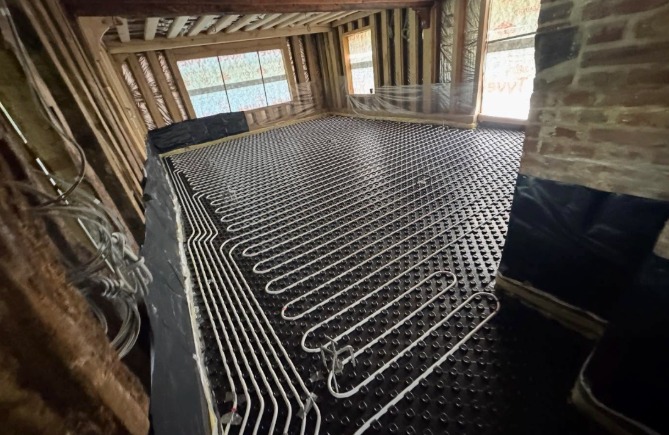
Here’s what that means for your project:
- Guaranteed System Performance – Screed isn’t just a layer to cover the pipes – it’s the way that heat gets transferred to the room. We will select the right liquid screed with the optimal thermal conductivity for your UFH system, ensuring it heats up quickly, distributes warmth evenly, and meets performance specifications every time.
- A Streamlined Programme – By managing both UFH installation and screeding, we are able to coordinate the process perfectly. There are no delays waiting for a separate screed contractor.
- One Team, One Responsibility – From the initial pipe layout to the pour, our team takes full ownership. This gives you one point of contact and complete confidence that the job will be done right.
How Liquid Screed Maximises Thermal Performance
Every underfloor heating system faces the same challenge – how to move the heat generated in the pipes into the living space as efficiently as possible. The solution is thermal conductivity, and this is why your choice of screed is so important.
If a traditional “dry” sand and cement screed is laid over the pipes, it inevitably leaves tiny air gaps. Air is a poor conductor of heat (an insulator), so these gaps act like a barrier, forcing your boiler to work harder and longer to heat the room.
Liquid screed, however, is fluid. It flows around the pipes, filling every last millimetre of space and creating a perfect, solid bond. By eliminating those insulating air gaps, the heat from the pipes transfers directly and rapidly into the screed and, subsequently, into your room. It’s this total contact that creates the total efficiency and responsiveness of any UFH system.
Your UFH Installation Questions Answered
We get asked a lot of practical questions about underfloor heating. Here are some of the most common ones, with straightforward answers from our expert team.
How long does a typical UFH and screed installation take?
For an average-sized project (around 100m²), the pipe installation usually takes 1-2 days, followed by the liquid screed pour on the next day. The screed is typically dry enough for light foot traffic in 24-48 hours, allowing other trades to continue their work.
What flooring can be used with underfloor heating?
Most flooring is compatible. Hard surfaces like tile, stone, and luxury vinyl tile (LVT) are excellent conductors. Engineered wood and specific carpets designed for UFH are also great options. It’s always best to check the manufacturer’s specification for suitability.
Is underfloor heating expensive to run?
No, it’s one of the most efficient ways to heat a space. Because it distributes heat evenly from the entire floor area, it can run at a much lower temperature (around 25-35°C) than traditional radiators (60-75°C). When paired with the high thermal conductivity of liquid screed, this efficiency leads to lower energy bills.
How can you install UFH in a renovation without losing ceiling height?
This is a concern in retrofits. We use specialist low-profile UFH systems which are incredibly thin (as little as 15mm). These are then covered with a self-levelling compound, which only requires a minimal depth to be effective. This combination adds very little height to the existing floor.
UFH and Buxton Flow Screeds – the Perfect Combination
A successful underfloor heating installation relies on treating the pipes and the screed as a single, integrated system. Using the right liquid screed is critical in you are to achieve the efficiency, responsiveness, and long-term reliability you want from underfloor heating. By choosing a specialist like Buxton Flow Screeds, with expertise in both disciplines, you ensure the entire floor is engineered for optimal performance.
For expert advice and a no-obligation quote for your project, call our team today – 020 3369 3396/07590 625100


