
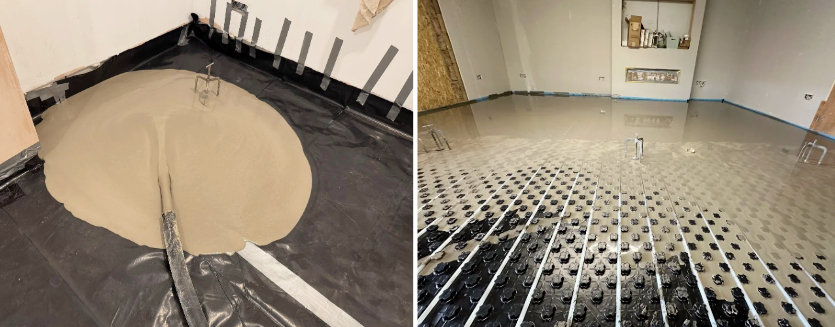
Self-Levelling Compound vs Traditional Screed – What’s the Difference?
Understanding Floor Levelling Options – When to Use Compound vs Screed
The success of any new floor comes down to the careful prep that goes into the surface below. A level, stable subfloor ensures your final flooring looks great and performs well for years. But choosing the right material for your subfloor can be confusing. You may find yourself wondering: Self-levelling compound vs traditional screed – what is the difference? Making the wrong choice can be costly.
In this blog we clear up the confusion, explain the differences, and outline when each option is the ideal fit.
Knowing which flooring material to use comes from experience. For over 20 years, Buxton Flow Screeds has been a trusted UK supplier and installer of screeds and compounds. We’ve worked on everything from home extensions to large-scale commercial floors, all the while gaining invaluable insights. Now we’ll apply our practical knowledge to help simplify your decision-making process.
What’s the Difference? Traditional Screed and Self-Levelling Compound Explained
While both traditional screed and self-levelling compounds prepare floors for their final finish, they tackle different problems and have different characteristics. It’s like using sandpaper vs. a plane on wood – both smooth the wood, but they’re used at different stages and for different reasons.

Traditional Screed – The Foundation Builder
- What it is – Traditional screed is made up of a simple mix of sand, cement, and water. Its consistency is damp and firm when applied.
- Primary Use – This type of screed creates the depth and level of a floor, over a base slab or insulation. It brings the floor up to the desired height, and it’s usually applied at a thickness of 40mm or more.
- Finish & Application – Its job is to create a functional, reasonably flat surface suitable for many finishes. Traditional screed requires skilled manual application (trowelling, compacting, smoothing). It’s generally more labour-intensive and slower to dry fully than thin-layer compounds.
Self-Levelling Compound – The Finishing Touch
- What it is – Self-levelling compound is a cement-based powder with added polymers, which is mixed to a fluid, pourable consistency.
- Primary Use – Used for smoothing and levelling existing subfloors in thin layers (often 1-50mm). It flows into dips and corrects unevenness to create a perfect surface for sensitive floor coverings.
- Finish & Application – It creates a smooth, almost glass-like finish. Its self-levelling properties mean it’s quick to pour and dries fast, which is why it’s ideal if you’re working to a tight deadline.
Matching the Product to the Project – Typical Uses for Screed and Levelling Compound
Choosing between these materials often comes down to the specific problem you need to solve with your flooring.
Choose Traditional Screed If You Need To:
- Build significant height – Laying a floor in a new extension? Need to raise the level by a few inches? Traditional screed can handle this kind of task effectively. Be prepared, though, for the physical work involved in mixing, moving, and manually levelling it.
- Create a basic level over a large area – If you have a large expanse requiring substantial fill, traditional screed is often the base layer of choice, especially if minor imperfections aren’t critical for the final flooring.
Choose Self-Levelling Compound If You Need To:
- Smooth out an existing base – Got an old concrete floor that’s uneven or pitted? Need to get rid of trowel marks on an old screed? Self-levelling compound creates that smooth, flat surface over the top.
- Achieve a perfect finish for modern flooring – Installing vinyl click flooring, LVT, or thin laminate? These demand a super-flat subfloor, which self-levelling compound delivers in thin layers (typically 1-50mm).
- Optimise your Underfloor Heating – Retrofitting UFH? Using self-levelling compound over the pipes ensures they are fully encased. This density is important for eradicating voids in order to ensure excellent heat diffusion and even heat distribution.
- Work quickly on thin layers – Need to get the floor prepped fast? The pourable nature often makes application quicker than manually floating a traditional screed for thin corrections.
Pro Tips for Application – Working with Screed and Levelling Compound
Whichever material you choose for your project, understanding how to work with it ensures a smooth process and a great result.
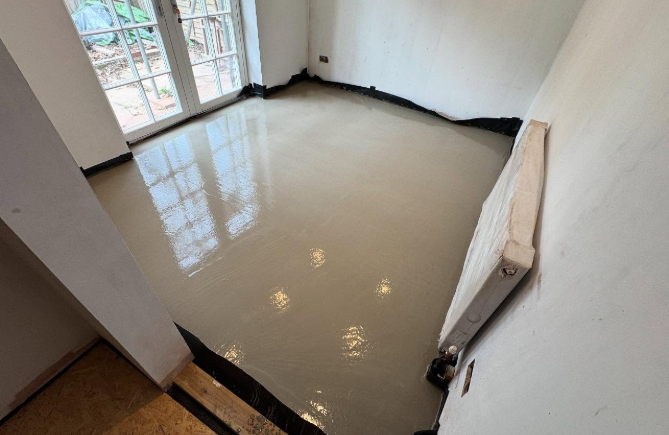
Traditional Screed – Experience Counts:
Laying traditional screed perfectly level takes practice. It’s about getting the mix right, applying consistent pressure, and expertly working the surface. While it’s a strong solution, achieving that professional, super-flat finish requires an experienced installer, especially to avoid inconsistencies over larger spaces.
Self-Levelling Compound – Plan for Pace:
The beauty of self-levelling compounds includes their rapid setting time, which helps keep projects on track. This feature does mean, though, that you need to be prepared for quick work. Typically, you have a window of around 15 minutes after mixing before your flooring starts to cure.
To make the most of this, and ensure a flawless floor, we recommend using a specialist pump to apply your self-levelling compound. This allows for continuous pouring and consistent coverage before the compound begins to harden, delivering that smooth finish effectively.
Buxton Flow Screeds – End-to-End Service For Your Flooring
At Buxton Flow Screeds, we not only supply the products you need for your flooring, we also offer full support and installation for your flooring projects. For projects across the UK, you can rely on Buxton Flow Screeds for robust flooring solutions and consistently excellent results.
Whether you need expert advice on choosing the right solution or a quote for supply and professional installation, the Buxton Flow Screeds team is here to help. Contact us today – 020 3369 3396/07590 625100


