
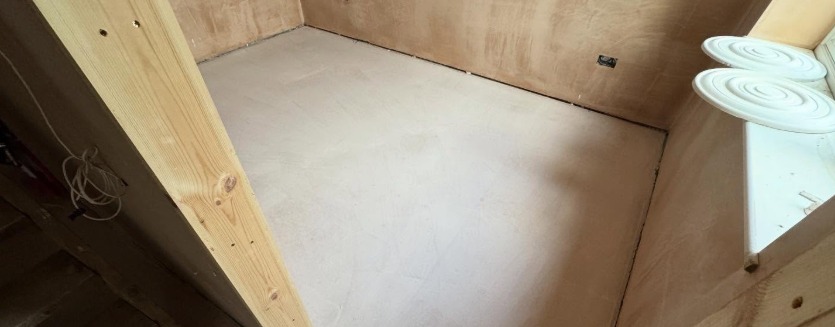
Professional Fix for Uneven Concrete Subfloors
Precision Levelling – A Blueprint for Subfloor Restoration
When you’re dealing with a 15mm deviation across a warehouse floor you need a specialist approach. Our professional fix for uneven concrete subfloors starts with a laser-level survey to establish a clear datum point across the entire area. We don’t use filler; we use high-performance self-levelling compounds designed to bond to the substrate and stay there.
Buxton Flow Screeds focuses on the mechanics to get the job done – surface tension, bond strength, and a flat finish that meets UK building standards.
Identifying What Went Wrong with the Pour
We start by looking for the root cause of the deviation. If you pour 50mm of high-spec screed over a subfloor that is still moving, you’re throwing money away. You need to know exactly why that slab isn’t hitting its datum points.
The usual suspects:
- Structural Movement – Temperature swings in uninsulated warehouses cause the concrete to expand and contract, shearing the bond of substandard screeds.
- Aggregate Segregation – When a mix is too wet or over-worked, the heavy aggregate sinks and the fines rise. This creates a soft, dusty surface that can’t support high-traffic loads.
- Sub-Base Voids – Air pockets trapped during the pour (honeycombing) create soft spots that crumble and give way once you install heavy racking or equipment.
- The Patchwork Effect – Old repairs using non-compatible materials shrink at different rates, pulling away from the original slab and creating ridges.
Which SR Class Does Your Floor Need?
SR Class | Tolerance | Use Case |
High Spec (SR1) | 3mm | Mandatory for thin-gauge vinyl or resin finishes where every ripple shows. |
Standard (SR2) | 5mm | The industry benchmark for most UK commercial builds. Covers most bases. |
Utility (SR3) | 10mm | Only for areas where flatness isn’t a priority. Avoid for heavy machinery. |
Engineering the Substrate for Heavy-Duty Use
Buxton screeders engineer a new surface using pump-applied, cementitious compounds that bond directly to the existing slab. This creates a substrate with a compressive strength (often C35 or higher) that can handle point-loading from heavy racking and forklifts.
The Specialist Advantage:
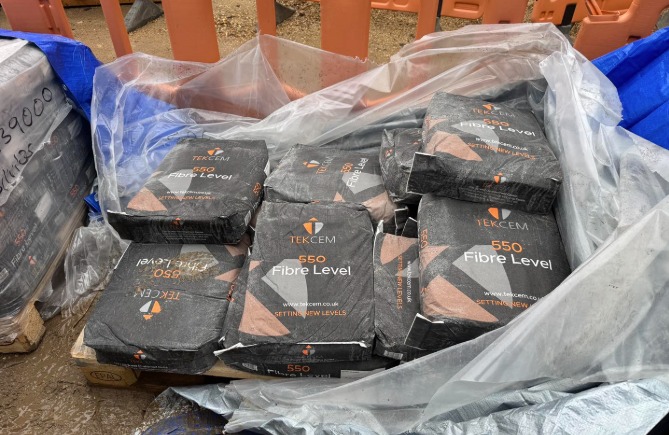
- Wet-on-Wet Application – We pump high volumes of material to maintain a wet edge, eliminating the cold joints that cause weak spots in hand-mixed applications.
- Rapid Commissioning – Most of our compounds can handle foot traffic within 2–4 hours. So you don’t lose a week waiting for the floor to dry.
- Structural Bond – By mechanically preparing the slab (grinding or shot-blasting), we make sure the compound becomes part of the floor structure rather than just sitting on top of it.
- Consistent Curing – These compounds are engineered for low-shrinkage. You won’t see the curling or cracking typical of standard sand-and-cement screeds at thin depths.
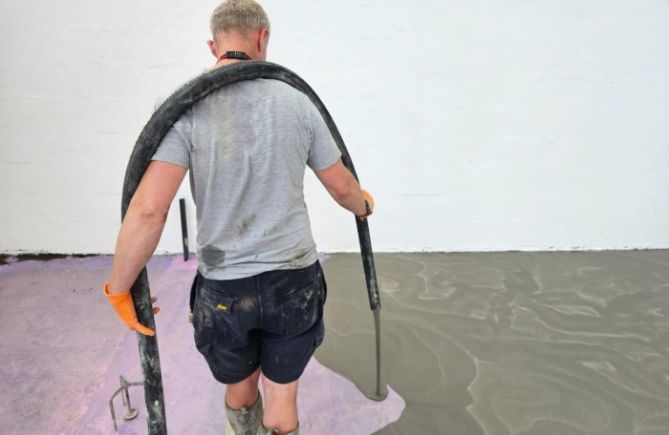
Managing the Window – How We Achieve a Precision Pour
Self-levelling compounds have a narrow ‘open-time’. Once the chemical reaction starts, you have around 15 minutes to complete the pour. We manage this through high-volume pumping and coordinated site logistics.
- Establishing the Datum – We use laser levels to set datum points across the slab, ensuring we hit the exact finished floor level (FFL) required.
- Controlling the Mix – Our pump systems ensure a perfect water-to-powder ratio. Too much water kills the C35 compressive strength; too little, and it won’t flow.
- Continuous Pumping – By pumping directly to the point of use, we eliminate the delays of hand-mixing, allowing the material to find its own level without tunnelling.
- Active De-aeration – Spiked rollers break surface tension and remove air pockets. This results in a dense, case-hardened finish ready for heavy traffic.
- Rapid Commissioning – Most sites are trafficable for foot traffic in 4 hours. We coordinate the pour so your following trades can get back to work the next morning.
The 3 Most Common Subfloor Failures (And How We Avoid Them)
The margin for error on a commercial slab is razor-thin. A floor can look perfectly level on the day of the pour, but fail six months later when heavy traffic hits a weak bond. Here is what can go wrong if you ignore the physics of the slab in favour of a quick finish.
1. Delamination (Bond Failure):
- The Failure – The new screed pulls away from the concrete, sounding hollow when it’s walked on. This usually happens because the laitance (weak, dusty layer on top of new concrete) was left in place.
- The Fix – When laitance appears it needs grinding to strip the slab back to the aggregate, creating a high-surface-area mechanical key for the compound to bite into. Take a look at our ‘Laitance Removal’ guide.
2. Pin-holing and Bubbling:
- The Failure – Small craters appear on the surface as the compound cures. This is ‘outgassing’, caused by air escaping the dry concrete and blowing through the wet screed.
- The Fix – Use high-build, dual-coat primers to completely seal the porosity of the substrate’s. You need to lock the air into the slab to stop it ruining the finish.
3. Tunnelling and Cold Joints:
- The Failure – Visible ridges or lines where one batch of screed met another. These are structural weak points.
- The Fix – We use high-capacity pumps to maintain a constant flow rate and a wet edge, so the floor cures as a single unit.
Subfloor Restoration – FAQs
When we’re managing large-scale commercial or industrial floor repairs, there are questions we hear regularly from our clients. Here are our answers to them.
1. How thick can a professional self-levelling compound be applied in one go?
Standard smoothing compounds are typically applied at depths of 2mm to 10mm. However, for significant subfloor deviations, we use high-build, fibre-reinforced compounds that allow for a single-pour thickness of up to 50mm.
2. Can self-levelling compound be used over underfloor heating (UFH) systems?
Yes, it is the ideal solution for encasing both electric and water-based UFH. The liquid nature of the compound ensures total “encapsulation” of the pipes or cables, eliminating air pockets and significantly improving thermal conductivity.
3. Is the finished compound durable enough to be left as a final floor?
Most standard self-levelling compounds are designed as ‘underlayments’ requiring a final floor covering like resin, vinyl, or tile to protect them. If we’re working in industrial environments, though, we can specify industrial grade screeds. These are engineered to withstand direct forklift traffic and heavy machinery without the need for additional coverings.
Precision Levelling Without the Lag
The Buxton Flow Screeds team arrives with high-output pumps capable of delivering a seamless pour across hundreds of square metres in a single shift. This pump-applied approach ensures we hit an SR2 finish across the entire floor plate and maintain your schedule. Get a flawless, durable finish in under two days.
Call Buxton Flow Screeds to discuss your project requirements and discover how our rapid-set solutions can level up your concrete flooring – 020 3369 3396/07590 625100


