
Floor Screed London
Choosing the Right Screed for Your Build
When installing floor screed in London always start with careful consideration of the subfloor and the finish. Part E regulations governing multi-storey residential conversions demand strict acoustic compliance, for example. Ground-floor extensions need high thermal transfer over wet underfloor heating pipes. Commercial basements require fast-curing mixes to keep trades moving.
Buxton Flow Screeds has been supplying and installing London sites for over two decades. We know from experience, therefore, that choosing the wrong screed leads to unbonded cracking, blown levels, and delays. In this blog we look at how traditional sand-and-cement compares against cementitious and anhydrite liquid screeds for London builds; we’ll be covering load times, minimum depths, and site preparation.
Which Screed is Right For Your Floor?
You can walk onto any London site and you will most likely see one of three screed types specified. In the table below we show how each one behaves differently once poured, especially when it comes to depth restrictions and drying times.
Metric | Traditional Sand & Cement | Anhydrite Liquid Screed | Cementitious Liquid Screed (e.g. Cemfloor) |
Application Method | Hand-trowelled dry mix | Pumped liquid pour | Pumped liquid pour |
Minimum Depth (Floating / UFH) | 65mm–75mm | 35mm–40mm (25mm over pipes) | 35mm–40mm (25mm over pipes) |
Foot Traffic Window | 5 to 7 days | 24 to 48 hours | 24 to 48 hours |
Surface Laitance Sanding | Not required | Removal essential within 5-14 days | None required |
Drying Speed to Final Floor | Slow (approx. 1mm per day) | 1mm/day up to 40mm, slower beyond | Rapid cure; ready for tiles in days |
If you have tight finished floor level thresholds, traditional dry screed is usually out of the question because it needs substantial thickness in order to stop it curling or cracking.
Managing Depths Across Common London Build-Ups
London properties often have awkward floor profiles – uneven Victorian joists, for example, or rigid ceiling heights in basement digs. It’s your subfloor that determines your minimum screed thickness:
- Bonded over concrete slabs – 25mm minimum thickness. The concrete is primed and keyed so the screed bonds mechanically to the base.
- Unbonded over a DPM or membrane – 30mm minimum thickness. Used where damp protection is needed or where the underlying slab might shift slightly.
- Floating over acoustic insulation (Flats / Part E) – 35mm to 40mm minimum. Acoustic battens or high-density insulation isolate sound transmission between tenancies.
- Poured over wet underfloor heating (UFH) – 40mm total depth (giving 25mm minimum coverage over the top of 15mm–16mm pipes). This optimises heat output while keeping the weight down.
Getting Material on Site in London
Pouring screed in London is easily 70% to do with logistics. Everything takes planning and proactive management as we show below:
- Red Routes & Parking – We arrange parking suspensions with the local borough or schedule drops outside peak traffic hours to keep the city’s red routes clear.
- Easy Access Equipment – We use truck-mounted or trailer pumps that sit neatly in a single parking bay, so there’s no need to park up a bulky mixing plant on the pavement.
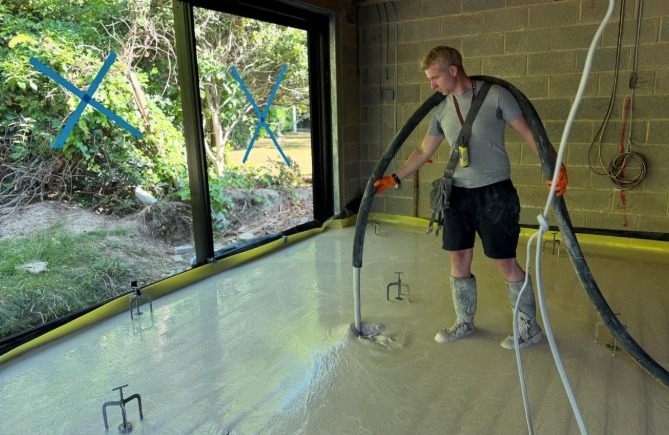
- Flexible Pipe Runs – Instead of running wheelbarrows of concrete through your hallway, our flexible delivery pipes run up to 150 metres through doorways, narrow side passages, or straight through a front window.
- Upper Floor & Basement Pumping – Liquid mixes pump vertically with ease, reaching third-floor flats or sub-ground basements without the risk of damaging shared hallways.
Pour to Final Flooring – Here’s Your Timeline
Liquid screed (anhydrite or cementitious) needs managed curing before you lay tiles, engineered wood, or vinyl. Here is what the timeline looks like on a typical build:
- 24 to 48 Hours – The surface is solid. It’s OK for light foot traffic from other trades. Keep windows closed for the first 24 hours to prevent draughts causing uneven surface drying, then open them up for ventilation.
- 7 Days – Underfloor heating can be commissioned and slowly brought up to temperature to accelerate drying (following manufacturer ramp-up instructions).
- 14 to 28 Days – Cementitious liquid screeds reach standard moisture levels suitable for tiling and moisture-tolerant finishes.
- Anhydrite Curing Time – 1 mm per day up to 40 mm thick, and 0.5 mm to 2 mm per day for thicknesses beyond that.
- Final Moisture Check – Always run a digital hygrometer test or carbide bomb test before laying impervious floor coverings (moisture must sit below 75% RH for wood and LVT).
Floor Screed London – FAQs
Here are answers to questions we get asked regularly about London site prep and technical standards:
Do we need a council permit if the pump hose crosses the public pavement?
Yes. If the delivery vehicle is parked on the street and the hose crosses a public footway, London local authorities require a Section 171 highway licence or standard pavement permit.
Should underfloor heating pipes be pressurised during the pour?
Yes. Keep your manifold pressurised with water to at least 4 to 6 bar before and during the pour. Pressurised pipes are rigid enough to resist any displacement as the material flows, and if a pipe takes accidental damage during screeding, the pressure drop alerts the team immediately before the material sets.
Can we pour liquid screed in wet rooms and ground-floor bathrooms?
You can but screed choice is particularly important. Calcium sulphate (anhydrite) screeds soften if exposed to persistent moisture. For bathrooms and wet rooms, specify a cementitious liquid screed (such as Cemfloor) and apply a certified liquid tanking membrane over the cured surface before laying tiles.
Do all liquid screeds produce laitance that has to be sanded off?
No. Laitance only occurs on anhydrite flowing screeds. If you don’t want to sand, choose a cementitious liquid screed such as Cemfloor. Cement-based liquid screeds cure without forming a friable top skin, so your flooring contractors can prime and tile directly onto the surface once dry. See our ‘Laitance Removal Guide’ for a detailed look at this process.
Get Expert Floor Screeding Support on Site
If you have a residential conversion, extension, or commercial project coming up in London, speak with Buxton Flow screed specialists who can give helpful advice and guidance on local site logistics.
Learn more about our plant capabilities, past installations, and pour capacities on our London liquid screed supply and installation page, or speak directly with our team on 020 3369 3396 to get a quote based on your square meterage.


