
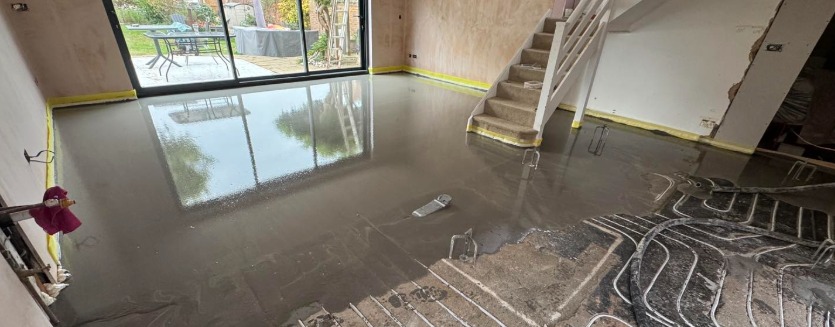
Floor Screeding Contractors Bedford
Flawless Floors and Peak UFH Efficiency with Bedford’s Screed Specialists
If you are installing underfloor heating or managing a building project, you already know that finding expert floor screeding contractors in Bedford is the determining factor in your floor’s long-term performance.
A long-lasting installation requires more than just a level surface – it needs a material that pours rapidly, dries uniformly, and eliminates the risk of cracking. You need a “pump-and-go” delivery that makes local reliability a priority and achieves thermal conductivity levels that traditional sand and cement simply cannot match.
With over twenty years of specialist installation experience, we know that reliability dictates your project’s success. At Buxton Flow Screeds, we have built a reputation across Bedfordshire as the experts who arrive on time and deliver a flawless result. We manage every technical detail, ensuring your floor is perfectly level, thermally efficient, and engineered to last.
Why Liquid Screed Is Right For Every Project
Want a flawless surface without having your site swarming with screeders? Then liquid screed is the solution. This material adapts to any foundation, providing a level of versatility traditional methods cannot match. We deploy a small, streamlined, team to guarantee a high-quality, precision pour on every project.
Buxton Flow screeders achieve massive coverage – up to 2,000m² per day – so your timeline stays tight and professional. Once installed, the screed can support light foot traffic within 24 to 48 hours. By the end of the first week, you can get on with force-drying to further accelerate your schedule, resulting in a consistently excellent finish.
Why Liquid Screed is Ideal for UFH Installations
Your underfloor heating system needs a high-conductivity material to function as it should. Liquid screed serves is the industry standard for UFH because its fluid consistency encapsulates the heating elements entirely, preventing the air bubbles that plague traditional sand and cement.
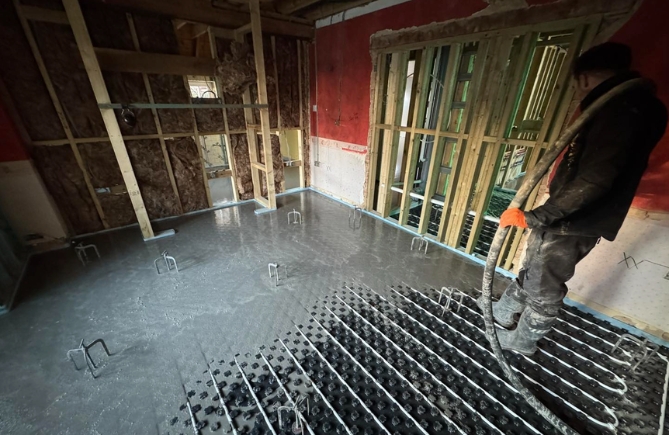
Without these air gaps, you achieve an efficient thermal bridge. Because we can pour liquid screed at a reduced depth without sacrificing strength, your floor gains a much faster thermal response time. This professional application ensures your UFH system operates with the exact efficiency and responsiveness promised by the manufacturer.
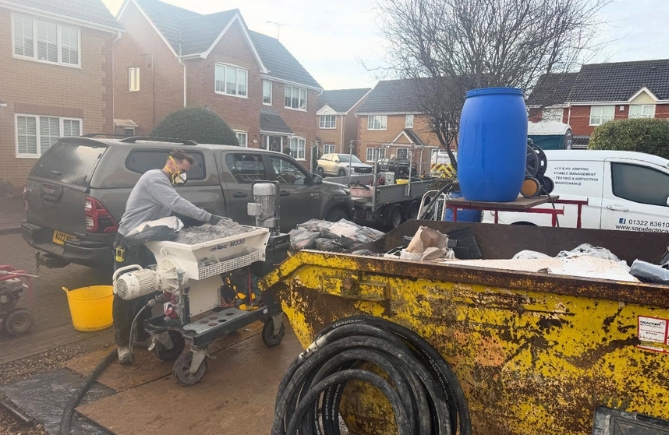
Site Preparation and the Pour Day Process
Achieving a flawless floor requires a collaborative focus on preparation. To prevent leaks and ensure a crack-free finish, we guide our clients through a site-readiness checklist. Before we arrive, ensure your building is sealed, the pour area is squeaky clean, and your insulation is laid flat, as any movement in the boards can compromise the final level of your floor.
Key Preparation Points:
- Precision Tanking – Use a continuous polythene membrane to seal the entire floor area.
- UFH Integrity – Make sure that all heating pipes are fastened securely to withstand the flow of the screed.
- Structural Expansion – Place perimeter strips to manage the floor’s natural movement.
- Access Clearance – Mark out a solid floor area for our machinery to ensure a continuous, uninterrupted pour.
Download our Liquid Screed Preparation Guide for a detailed walkthrough.
When the Buxton Flow Screeds team arrives, our focus is on speed and accuracy. We set our datum levels and pump the material directly into place, allowing it to flow into every void. By dappling the surface in two directions, we remove any imperfections and guarantee a level of flatness that simplifies your final floor covering. We deliver a finished foundation that is ready for the next stage of your build immediately.
FAQs – Specialist Guidance For the Post Pour Period
A successful floor depends on managing the post-pour phase with the same precision as the installation itself. Our Bedfordshire team has compiled the following answers to keep your project on schedule and your quality standards high.
1. How do I safely start my UFH system?
Wait a minimum of seven days before introducing heat to the floor. Start the commissioning phase at a low baseline (approximately 20°C) and raise it by 5°C increments daily. This methodical approach forces out residual moisture evenly, preventing structural stress and ensuring the screed reaches peak thermal performance safely.
2. Where do we need to place expansion joints?
Large-scale or UFH-equipped projects require joints to manage the natural movement of the building. Typically, any area over 150m² or complex shapes with narrow corridors will need these breaks. By placing joints at these natural stress points, we protect your floor from the tension that causes unsightly cracks during heating cycles.
3. Can I use this screed in "wet" zones?
Liquid screed is an excellent choice for bathrooms, provided you prioritise waterproofing. Treat the screed with a dedicated tanking system before tiling. This professional preparation preserves the perfectly level foundation while creating an impermeable barrier against household moisture.
4. How do I prepare the surface for final tiling?
You must confirm the screed is sufficiently dry—target moisture content is below 0.5% for anhydrite products. Always conduct a professional moisture test before proceeding. Remember to sand the surface 7–10 days after the pour to remove laitance. If you don’t clear this dust-like layer your tile adhesive will fail.
Local Screeding Expertise You Can Rely On
A reliable, efficient surface is the backbone of a successful build. At Buxton Flow Screeds, we supply the material and deliver twenty years of expertise in navigating local Bedford sites. Our priority is always to use our experience to ensure your floor is installed correctly, the first time.
We provide comprehensive, no-obligation quotes designed to keep your project moving forward. Call Buxton Flow Screeds on 020 3369 3396 / 07590 625100


