
Is Underfloor Heating Expensive to Run?
The Truth About UFH Running Costs
Is underfloor heating expensive to run? The short answer is no – in fact, underfloor heating (UFH) can actually cost less to run than traditional radiators. Because UFH covers a larger surface area, it runs at lower water temperatures to achieve the same warmth.
But here is the secret to maximum efficiency – liquid screed. Unlike traditional dry screed, liquid screed flows to encase your pipes perfectly, offering superior thermal conductivity. This means your room heats up faster, your boiler works less, and your bills stay lower.
At Buxton Flow Screeds, we have spent over two decades supplying and installing UFH systems using high-performance liquid screed. We’ve seen firsthand how the right installation transforms a home’s energy profile. So, we’re not just guessing – we are experienced installers sharing honest, on-the-ground advice to help you get the most out of your renovation without the worry of high energy bills.
Why Liquid Screed Lowers Your Bills
As installers, we often get asked why we strongly recommend liquid screed over traditional “dry” sand and cement. It’s not just because it’s easier for us to pour – it’s because it fundamentally changes how your heating system performs.
It all comes down to thermal conductivity.
Put simply, thermal conductivity is how easily heat moves from your water pipes into the room. When you use traditional sand and cement, the mix is often manually levelled and can be quite “clumpy.” This creates tiny air pockets around your heating pipes.
Here is why air pockets matter – Air is an insulator (think of how double-glazing works). If there is air trapped around your pipes, your boiler has to work harder and burn more fuel just to push the heat past those air gaps and into your floor.
The “Liquid Screed” Advantage
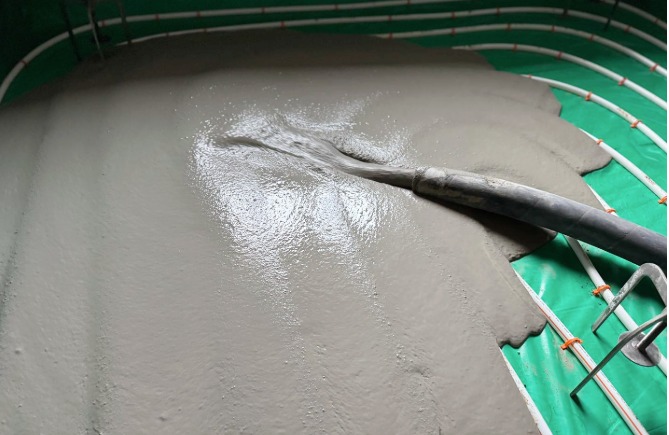
Because we pour liquid screed in a fluid state, it flows perfectly around every millimetre of your UFH pipes. It encases them completely, eliminating air bubbles.
This creates a direct path for the heat to travel. The result?
- Rapid Heat Transfer – The heat moves from the pipe to the surface much faster.
- Lower Input Temperatures – You can run your water temperature lower while achieving the same room temperature.
- Reduced Energy Consumption – Your heat pump or boiler doesn’t have to cycle as often or work as hard.
Thinner Floors Mean Faster Heat
Another massive benefit for renovators is the depth. Traditional screed usually needs to be laid 75mm thick. Liquid screed is far stronger, meaning we can install it as thin as 35mm to 50mm.
Less material to heat up means your floor responds faster. You won’t be waiting hours for the room to get warm, which gives you much better control over your thermostat and your spending.
Smart Thermostats and Zoning
One of the biggest myths we hear is that underfloor heating needs to be left on 24/7 to be efficient. While that was true for old, thick concrete floors that took half a day to warm up, modern systems are different – especially when paired with liquid screed.
To keep your running costs low, you need to be smart about where and when you heat your home. This is where zoning comes in.
Don’t Heat Empty Rooms
Zoning simply means treating each room (or area) of your house as a separate entity with its own thermostat.
- The Kitchen – Might need heat in the morning and evening, but not during the day.
- The Guest Bedroom – Might only need frost protection until you actually have guests.
With a radiator system, you often have one central thermostat for the whole house. With UFH, you have granular control. By only heating the rooms you are using, you can shave a significant percentage off your monthly energy bill.
The “Rapid Response” Factor
Because liquid screed is thinner and more conductive, it has a much faster “response time” than traditional screed.
- Traditional Screed – Takes 3-4 hours to warm up. You are forced to leave it running constantly because you can’t afford to let it cool down.
- Liquid Screed – Can warm up in under an hour (depending on the system).
This responsiveness means you can actually use “setback” temperatures effectively. You can let the heating drop by a few degrees while you are at work, knowing that your smart thermostat can boost it back up quickly just before you get home. You’re not paying to heat an empty house, and your home is warm and welcoming when you return.
Smart Thermostats do the Thinking for You
We always recommend pairing your installation with a smart thermostat system. These systems learn your habits and the specific heat-up time of your floor. They know exactly how long your liquid screed takes to reach temperature, firing up the boiler at the latest possible moment to ensure your home is warm exactly when you need it – and not a minute sooner.
Boilers vs. Heat Pumps
A common concern we hear from DIYers is, “Do I need to replace my entire heating system to get underfloor heating?”
The good news is that UFH is versatile. Whether you are sticking with a gas boiler or you’re installing a renewable heat pump, a liquid screed floor is the common denominator that maximises energy efficiency.
The Gas Boiler Bonus
If you are connecting your new UFH system to an existing condensing gas boiler, you will still see savings.
- Radiators – typically need water heated to 70-80°C to warm a room effectively.
- Underfloor Heating – (when encapsulated in liquid screed) usually only requires water at 45-50°C.
Because the return water temperature is cooler, your modern condensing boiler operates in its most efficient “condensing mode” more often. So, you’re burning less gas to get the same level of warmth and comfort.
The Heat Pump Partnership
If you are considering an air source or ground source heat pump, liquid screed UFH is essential to achieve peak performance.
Heat pumps are incredibly efficient, but they struggle to produce high temperatures (like those needed for radiators) without using excessive electricity. They operate best at low temperatures – ideally 35°C to 45°C.
Because liquid screed is so thermally conductive and encases the pipes so well, it allows the system to run effectively at these lower temperatures. It is the perfect partnership. The screed does the heavy lifting of transferring the heat, allowing the heat pump to tick over gently in the background, keeping your electricity usage to a minimum.
Comfort Without the High Cost
So, is underfloor heating expensive to run?
If installed correctly, quite the opposite. When you combine modern insulation with the superior thermal conductivity of liquid screed and smart controls, underfloor heating is one of the most cost-effective ways to heat a home. It allows you to use lower water temperatures and stop heating empty rooms.
At Buxton Flow Screeds, we don’t think that a warm home should come with a sense of dread when the energy bill arrives. With over two decades of experience in the industry, we know how to specify the right floor depth and screed type to ensure your renovation is future-proofed for efficiency.
Ready to get started?
Don’t guess with your floor build-up. Whether you are a self-builder at the planning stage or a DIYer ready to pour, let’s make sure your system is set up for success.
Contact Buxton Flow Screeds today for friendly, expert advice or a free quote – 020 3369 3396/ 07590 625100


