
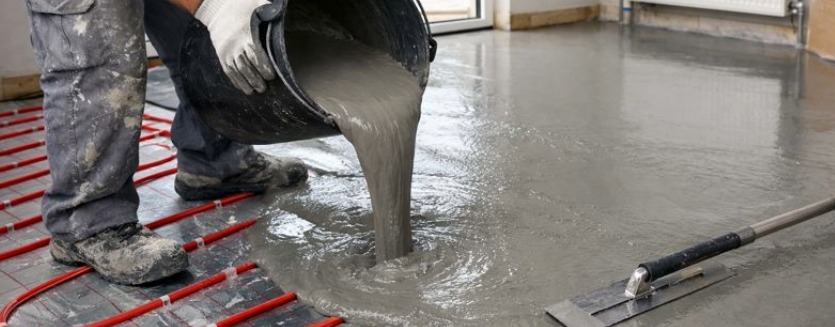
Crack-Free Microcement Over UFH
Discover Professional Techniques For a Flawless, Durable Finish
Applying microcement over underfloor heating doesn’t need to feel like a gamble. When it’s done right, this is a stunning, high-performance finish; done wrong, and you’re left with costly cracks. This guide is designed to give you practical advice for crack-free microcement over UFH.
We’ll help you avoid common DIY pitfalls so that your renovation looks (and stays looking) stunning.
At Buxton Flow Screeds, we’ve been installing liquid screed and microcement over UFH for over 20 years. Which means that we combine decades of subfloor expertise with the latest microcement innovations. We don’t just supply microcement – we’re on-site every day, ensuring every installation is built to last.
Why Does Microcement Crack? Understanding Thermal Movement
Microcement itself is incredibly strong, but it is also thin. When it’s applied over underfloor heating, the most common reason for it cracking isn’t the microcement – it’s movement in the material underneath it.
As your UFH system warms up and cools down, the substrate (the screed in which the UFH is laid) expands and contracts. If the screed hasn’t been properly commissioned or if it lacks the flexibility to handle these thermal changes, it will move.
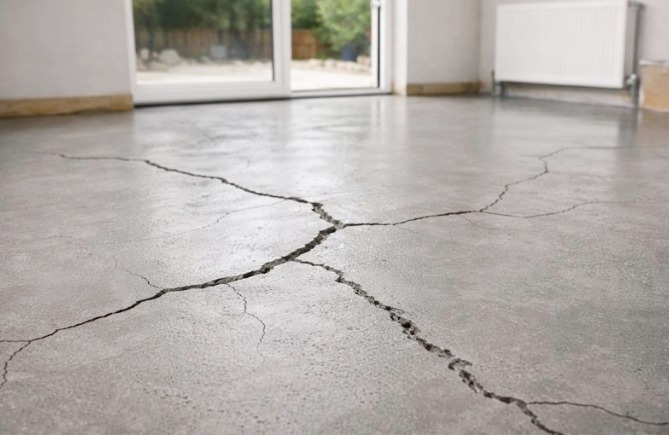
Because the microcement is bonded to the screed, any stress or shrinkage in the base layer directly impacts the top layer by creating cracks that reflect the movement below. At this point, it’s important to stress that this is a completely avoidable situation.
Reasons Why Microcement Cracks Over UFH
- Improper Commissioning – UFH not being cycled through its heat range before installation.
- Substrate Moisture – High residual moisture trapped under the finish.
- Thermal Expansion – Lack of flexibility in the microcement product to handle subfloor movement.
- Structural Voids – Air pockets in the liquid screed causing “hot spots” and uneven expansion.
The Science of Installing Microcement Over Underfloor Heating
We wouldn’t recommend installing microcement over UFH as a DIY project, and here’s why. Microcement systems like Forcrete are chemically “active”, so you have a narrow installation window before it begins to set. Without the confidence to handle these resins at speed and the technical knowledge of how they react to the ambient temperature of a UFH-equipped room, you risk “cold joints” or a patchy finish.
We recommend professional installation because our installers understand the science of the bond – ensuring the layers chemically fuse to create a heat-stable, multi-layered surface that won’t delaminate when the temperature rises.
The Professional Step-by-Step:
- The Heat Cycle – We check that the UFH has been correctly commissioned to stabilise the screed subfloor.
- Surface Profiling – Surface grinding creates the “key” needed for the primer to adhere for the long term.
- The Reinforcement Layer – A grit-seeded primer and fiberglass mesh are applied to absorb the tension of thermal expansion.
- Forcrete Application – We apply Forcrete microcement in thin, high-strength layers that provide excellent heat transfer.
- UV & Heat Sealing – The final seal is applied to stop any discolouration from the heat and to lock in a hard-wearing, easy-clean surface.
FAQs – Microcement & UFH
Got questions about choosing a microcement floor? Below, we’ve answered the most regular queries we hear at Buxton Flow Screeds.
1. Does microcement affect the heat output of my underfloor heating?
No – microcement is an excellent thermal conductor. Because it is applied in thin layers (typically 3mm), there is very little “thermal resistance” compared to, for example, timber boards or stone tiles. This means your room reaches the temperature you want faster, which reduces your energy consumption.
2. How long do I have to wait to turn the heating on after installation?
We recommend waiting 48 hours after the final sealer is applied before turning your UFH back on. When you do, you should increase the temperature gradually – by just 5°C each day – to avoid “shocking” the material.
3. Can I use microcement with electric "mat" UFH systems as well as water-based ones?
Yes, but the preparation differs. Electric mats create more “concentrated” heat zones than water-based pipes. To ensure a crack-free finish, the heating cables must be completely encapsulated in a high-quality smoothing compound or liquid screed first. This creates a stable, level base that distributes the heat evenly before the microcement layers are applied.
4. Will the heat from the UFH cause the microcement to discolour over time?
When using professional-grade systems like Forcrete, discolouration is not an issue. Older or low-quality microcements sometimes suffered from “yellowing” due to the heat reacting with certain polymers.
Expert Floors, Built to Last
Choosing microcement for your heated floors will give you stunning results, so don’t let technical complexity stand in your way. At Buxton Flow Screeds, we have two decades of liquid screed experience and we’re Forcrete approved microcement installers. We offer the perfect professional credentials to give you a floor that’s structurally sound and offers rapid warmth.
Ready to start work? Contact the Buxton Flow Screed team today for a free quote for your microcement installation – 020 3369 3396/ 07590 625100


