
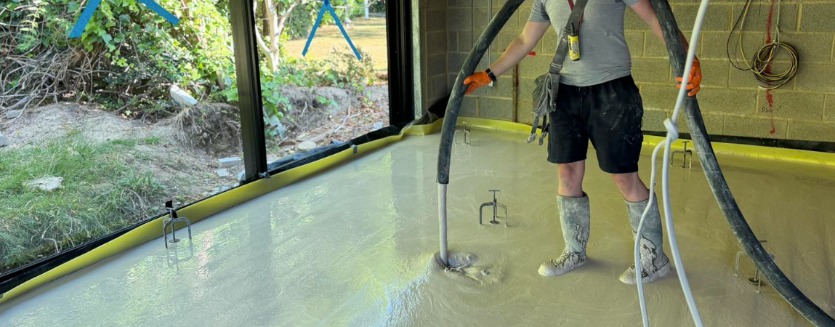
Liquid Screed’s Impressive Insulation & Acoustics
Build Better – Future-Proof Your Home Against Noise and Cold
When you choose liquid screed, you’re usually thinking about one thing – perfect heat transfer. It’s famous for that. But did you know that liquid screed’s impressive insulation and acoustics also dampens sound transfer between floors and seals your home against heat loss in ways that dry screed simply can’t.
These are the “hidden” upgrades that improve your home’s design. In this blog we’ll look at the technical reasons why liquid screed is the best insulation and acoustic decision you can make.
Why are we so confident about the benefits of liquid screed? Because at Buxton Flow Screeds, we’ve been pouring and perfecting floors for over two decades. We’ve seen the technology evolve and have helped self-builders and renovators on projects across the UK. As a result, we know exactly how a properly installed flow screed changes the feel and sound of a room, and we’re about to share that expertise with you.
How Liquid Screed Reduces Noise Pollution
Noise pollution inside the home is a big issue for renovators right now. Whether you need to meet strict Building Regulations for a new build, or you just want to avoid hearing the kids thudding around upstairs, your floor structure is the first line of defence.
Liquid screed offers acoustic encapsulation. When it’s installed over an acoustic insulation layer, liquid screed doesn’t just sit on top – it pairs with the insulation to optimise performance.
The Liquid Screed Difference:
- Reduces Flanking Transmission – Because liquid screed creates a seamless seal without any voids, it stops sound travelling around the edges of the room.
- Absorbs Vibration – The solid, non-combustible liquid screed mass creates a “dead” floor that doesn’t drum or echo when walked upon.
It’s a simple change in material specification but it delivers a massive upgrade in privacy and comfort.
How Liquid Screed Boosts Energy Efficiency
While acoustic comfort is about peace and quiet, thermal performance is about your household bills and your comfort. We’ve found that many self-builders install wall insulation but tend to overlook the floor. Liquid screed acts as an important component in your home’s thermal envelope (the barrier between the inside and outside).

Because liquid screed is self-levelling, it flows into every available space when poured. This creates a seal that traditional hand-applied screeds can’t match. This sealing property tackles a major enemy of efficiency – air permeability.
Air permeability describes how easy it is for air to flow through the fabric of your building. Yes – we’re talking about drafts. A floor with gaps lets warm air escape and allows cold air in. Liquid screed eradicates these gaps at the floor level, reducing air leakage and keeping your heat exactly where you want it.
Liquid Screed Explained – Frequently Asked Questions
With over two decades in the trade, the team at Buxton Flow Screeds has dealt with a whole load of questions about liquid screed. Here are the answers to the four most common queries we get from self-builders and renovators.
1. Why is liquid screed recommended for Underfloor Heating (UFH)?
That’s down to thermal conductivity. Liquid screed encapsulates the pipes perfectly with no air gaps. So, heat can transfer from the pipes to the room much faster than traditional screed, which means that your system works more efficiently, and your room warms up quicker.
2. What does "Thermal Mass" actually do for my home?
Thermal mass acts like a heat battery. Because liquid screed is dense, it absorbs heat while the heating is on and then slowly radiates it back out when the heating is off. This helps maintain a stable, comfortable temperature without constant boiler cycling.
3. How thin can you lay liquid screed?
This is one renovators really appreciate. We can lay liquid screed as thin as 35mm (depending on the specific product), whereas traditional sand and cement needs 65mm-75mm. It’s perfect if you are struggling with ceiling heights or door thresholds.
4. How long before I can walk on the floor?
In most cases, you can walk on the floor within 24 to 48 hours.
Experience Buxton Flow Screeds
We hope this blog has alerted you to some of the less discussed properties of liquid screed. It’s not just about the ease of installation – it’s about the comfort of living with great insulation and acoustics.
Buxton Flow Screeds has two decades of experience supplying and installing liquid screed for builders and renovators across the UK. This means that we can guarantee a precision install that ensures you will enjoy every single benefit we’ve discussed.
Let’s discuss your build.
Whether you have technical questions about depths or just want a price comparison, our team is here to help – 020 3369 3396/ 07590 625100


