

Retrofit Screed for Energy Efficient Heating
What’s the Best Screed for Retrofit Underfloor Heating?
When you’re retrofitting underfloor heating into an existing property, it’s the floor height that’s often the biggest challenge. Traditional sand and cement screeds require depth, which can force you to make adjustments to doors and skirting boards. And that – in turn – adds time to the job and can impact the character of the room
The ideal retrofit screed for energy efficient heating, therefore, needs to be very thin, while maintaining strength, and able to provide rapid heat transfer for maximum efficiency. Even better if it dries quickly so you can get onto the next stage of the install quicker.
This is where we can apply our expertise. Buxton Flow Screeds has been supplying and installing specialist liquid screeds for over two decades. We’ve worked on numerous retrofit projects, and we know the challenges UFH installers face. Our recommendations are built on years of practical, on-site experience, not just product datasheets. Which is why you can trust us to advise you on the best you to screed for your retrofit UFH system.
The Solution – High-Performance Levelling Compound
So, what is the screed that solves the challenges of retrofitting underfloor heating? We would recommend a self-levelling compound. Often referred to as a flow screed, this is an advanced, cement-based product engineered for precisely this kind of problem.
While traditional sand and cement mixtures are applied dry and manually compacted, a levelling compound is liquid. It’s pumped onto the floor, where its fluidity allows it to flow into every gap, creating a perfectly level, high-strength base for the final floor finish.
Here’s exactly why it outperforms traditional methods for retrofit UFH:
1. Ultra-Thin Application Without Loss of Strength
Levelling compound can be laid at a minimal depth, (10- 20mm) over the heating pipes. This is a fraction of the 65-75mm needed for traditional screed, which means that issues with doorways, skirting boards, and ceiling heights are eliminated.
2. Complete Encapsulation of Heating Pipes
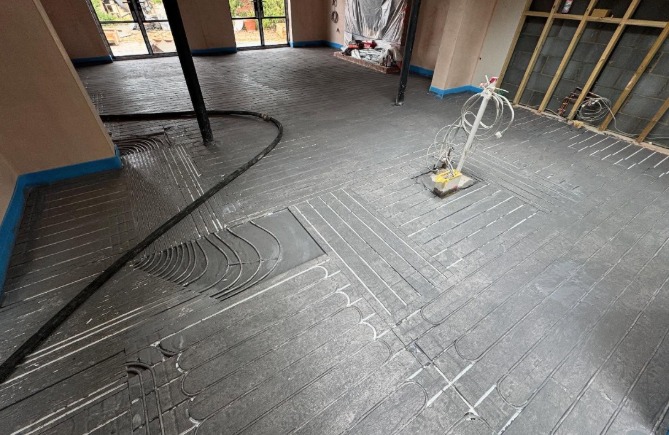
The liquid consistency is a major advantage for retrofitted UFH. It flows around the entire circumference of the pipe, creating total contact with no air voids. Air is a poor conductor of heat, so these voids (common in dryer mixes) create insulating pockets that trap heat and reduce system efficiency. Flow screed that hugs the pipes closely guarantees the most direct path for heat to travel from the pipe into the room.
3. Excellent Thermal Density for Rapid Heat Transfer
Levelling compounds are formulated to be dense, though thin. This high thermal mass, combined with direct pipe contact, gives you excellent thermal conductivity. In practical terms, this means the screed heats up very quickly and transfers that heat to the floor surface efficiently. This means the system can run at lower water temperatures, which reduces energy consumption and running costs. The same benefits obviously apply for heat pump installation.
Working with Levelling Compound – A Note on Speed and Skill
An important practical consideration when using a levelling compound is its working time. Once the material is mixed, the clock starts ticking, and you typically have a 20–30-minute window to pour, level, and finish the area before it sets. This demands a confident and organised approach to installation.
If you’re experienced in working with flow screeds, you’ll be prepared for this pace of work. If, however, this is your first time working with a rapid-setting compound, the speed required can be a bit of a challenge. Hesitation or unforeseen delays can result in a botched finish.
For this reason, we always advise bringing in a specialist screeding team. It’s the best way to achieve a perfect result on the first attempt.
Frequently Asked Questions
The first time you work with any new material requires clear, technical information to give you confidence. That’s why we’ve compiled answers to a few regularly asked questions.
How long after pouring the levelling compound can I commission the UFH system?
You should be able to walk on the floor after a few hours and allow the use of light traffic after a day or two. The heating system shouldn’t be commissioned though, until the screed has fully cured. For most cement-based levelling compounds, this means a gradual heat-up process can begin after 7 days.
What level of subfloor preparation is needed before pouring?
The subfloor must be structurally sound, clean, and free of any dust, grease, or contaminants. All timber substrates will need a decoupling membrane, and concrete floors must be primed with a suitable acrylic primer (see manufacturer’s instructions) to seal the surface and prevent the screed from drying out too quickly.
Do I still need to use a perimeter expansion strip with such a thin levelling compound?
Yes, regardless of the screed’s thickness, it will expand and contract slightly with temperature changes. The perimeter strip absorbs this movement, stopping the screed from pushing against the walls and cracking under pressure.
Get Expert Advice From Screeding Specialists
Selecting the right screed is a hugely important step for delivering a high-performance, energy-efficient heating system. When you choose a high-quality levelling compound, you’re creating a solid foundation for your project right from the start.
We always see ourselves as partners to the installers and renovators we work with. If you’re planning a retrofit UFH system, give us a call or message us. We can help you choose the right screed, so your installation runs smoothly.
Get in touch with the Buxton team today – 020 3369 3396 or 07590 625100


