
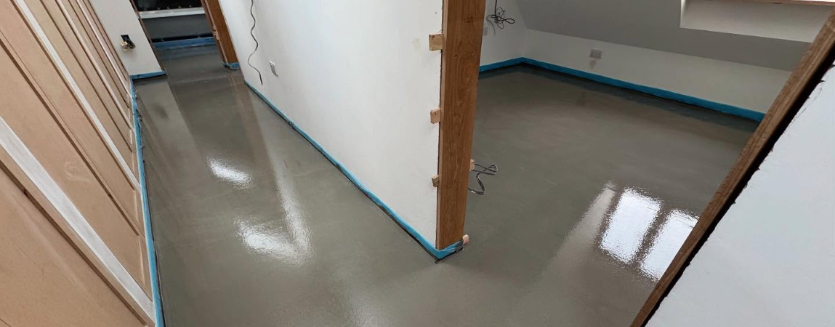
When Levelling Compound Beats Liquid Screed
When to Choose Levelling Compound Rather Than Liquid Screed
If you’re scratching your head, wondering what the difference is between levelling compound and liquid screed, you’re in the right place. Whether you want to know when levelling compound beats liquid screed, or whether the application is different, we’re here to clarify. Our aim, in writing this blog is to demonstrate how, and when, levelling compound can be the better option for your flooring project.
Here at Buxton Flow Screeds, we’re trusted suppliers of both liquid screed and levelling compound. Beyond that, though we have two decades of hands-on experience using these flooring materials. Our expertise, working with clients from UFH installers to self-builders, means we know the difference between liquid screed and levelling compounds.
Spot the Difference – Liquid Screed vs. Levelling Compound Explained
If you’re a renovators, contractor or builders, you already know that choosing the right subfloor preparation product is important. So, knowing how liquid screed and levelling compound are different is key to making the right choice. Let’s start by being clear about what each of them do, and where they’re different.
Defining Liquid Screed
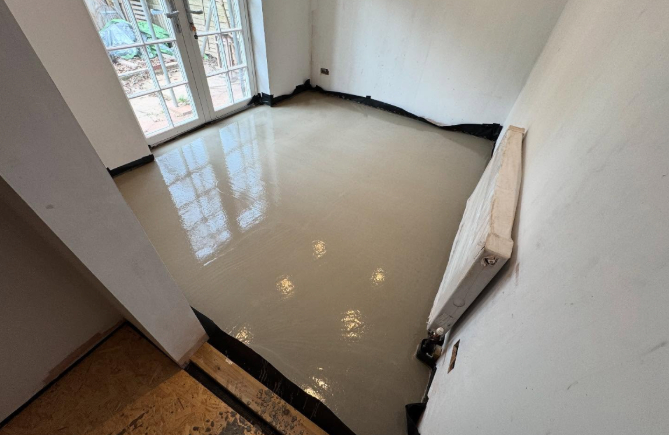
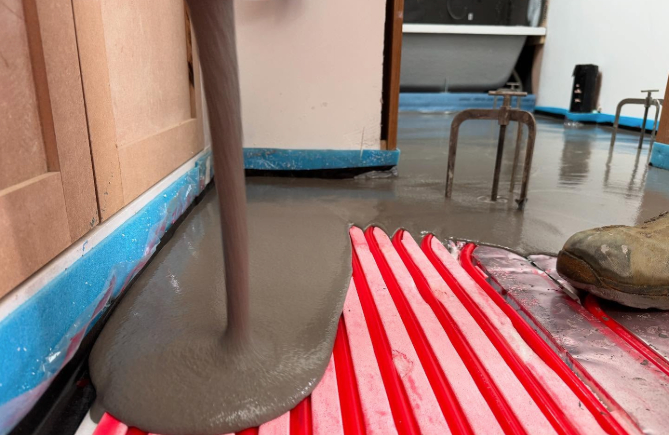
Liquid screed is the foundation layer normally used in new builds or major renovations. It’s a pourable, self-compacting material, usually cement or anhydrite based. It’s designed to create a level and durable base at thicknesses typically starting from around 25-40mm. Liquid Screeds excellent flow makes it perfect for covering large floor areas and its thermal mass makes it a great option for encasing underfloor heating systems.
Defining Levelling Compound
Levelling compound is a finishing or corrective product. These are generally advanced, polymer-modified cementitious formulations applied in much thinner sections – from a fine feather edge up to 30mm or more for specific products. They smooth out irregularities on existing concrete or screed subfloors, or to provide a super-smooth, thin topping before the final floor covering is laid. The rapid curing time is a major characteristic.
Key Differences Between Levelling Compound and Liquid Screed
• Layer Thickness:
- Liquid Screed – Thicker layers (e.g., 25-80mm+).
- Levelling Compound – Thinner layers (e.g., feather edge to 30mm, some specialist ones thicker).
• Main Function:
- Liquid Screed – Forms a new structural screed layer.
- Levelling Compound – Smooths, resurfaces, or finely adjusts existing substrates.
• Project Type:
- Liquid Screed – Ideal for new constructions, extensions, large scale UFH installations.
- Levelling Compound – Perfect for renovation projects, rectifying uneven floors, or as a thin, fast-track topping, retrofitted UFH.
• Setting Speed & Workflow:
- Liquid Screed – Slower to dry fully, influencing project timelines.
- Levelling Compound – Rapid setting allows for quicker installation of floor finishes, but this demands a fast, precise, and often pumped application to manage workability.
• Flexibility in Application:
- Liquid Screed – Typically requires pumping over larger areas.
- Levelling Compound – Can be hand-applied for patches, but pumping is essential for larger areas or when speed and a flawless thin finish are paramount.
When Levelling Compound Beats Liquid Screed
Here we are at the crux of the matter – when should you reach for a levelling compound for your job? You’re looking for the option that will achieve a flawless, durable finish. Here are a few scenarios where levelling compound wins out:
1. When You’re Dealing with an Imperfect Existing Subfloor
Working with uneven concrete or screed base in a renovation? Levelling compound is the ideal way to smooth out imperfections, creating a flat and flawless surface for your final floor covering.
2. When You Need to Avoid Height Build-Up
When you’re matching levels to an existing floor, avoiding issues with door clearances, or dealing with fixed thresholds – levelling compound is what you need to reach for. It can be applied in very thin layers (even down to a feather edge) without compromising its strength.
3. Tight Deadlines and Quick Turnarounds
Levelling compounds cure faster than liquid screeds. Many allow for foot traffic within a few hours and floor coverings to be laid the next day. This rapidity means application, especially when pumped for larger areas, needs to be fast and skilful – otherwise you end up having to redo the whole floor.
4. Retrofitting Underfloor Heating (UFH)
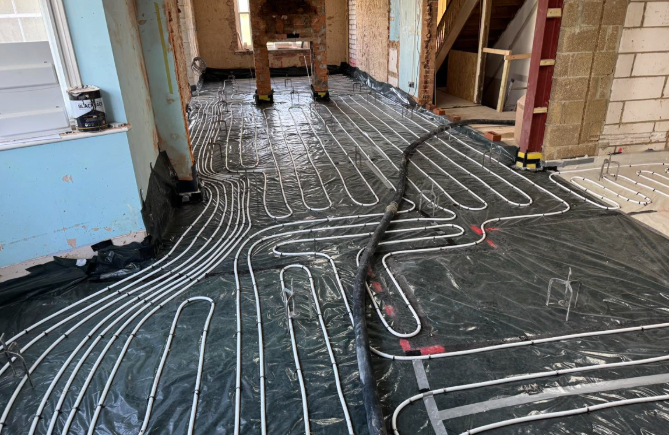
Levelling compounds can be applied thinly over electric UFH mats or low-profile piped systems. This minimal thickness not only preserves existing floor height but also provides excellent thermal responsiveness – the heat transfers quickly and efficiently to the room because the compound is in such close contact with the heating elements.
5. Preparing for Delicate or Thin Floor Coverings
If you’re installing Luxury Vinyl Tiles (LVT), sheet vinyl, linoleum, or even some thin engineered woods, the subfloor has to be very smooth. Any imperfections will be felt and seen. Levelling compounds create an exceptionally flat, level surface, so your new flooring looks and feels flawless.
6. Creating Transitions (Feather Edging)
Need a smooth transition between different floor levels or feather out an edge to nothing? Levelling compounds excel at this, providing a neat, almost invisible gradient that liquid screeds just can’t achieve.
Your Perfect Subfloor Starts with Buxton Flow Screeds
For over two decades, Buxton Flow Screeds has been a trusted choice across the UK, providing not just materials but complete flooring solutions. Whether you’re a contractor needing a reliable supplier, a self-builder needing friendly advice, or an UFH installer wanting a professional application, we can help. We’ll take you from initial guidance and product selection through to installation and completion of your flooring job.
Take the guesswork out of your next flooring project. Contact the friendly professionals at Buxton Flow Screeds today for comprehensive support – from supply to expert screeding services – 020 3369 3396/ 07590 625100


